
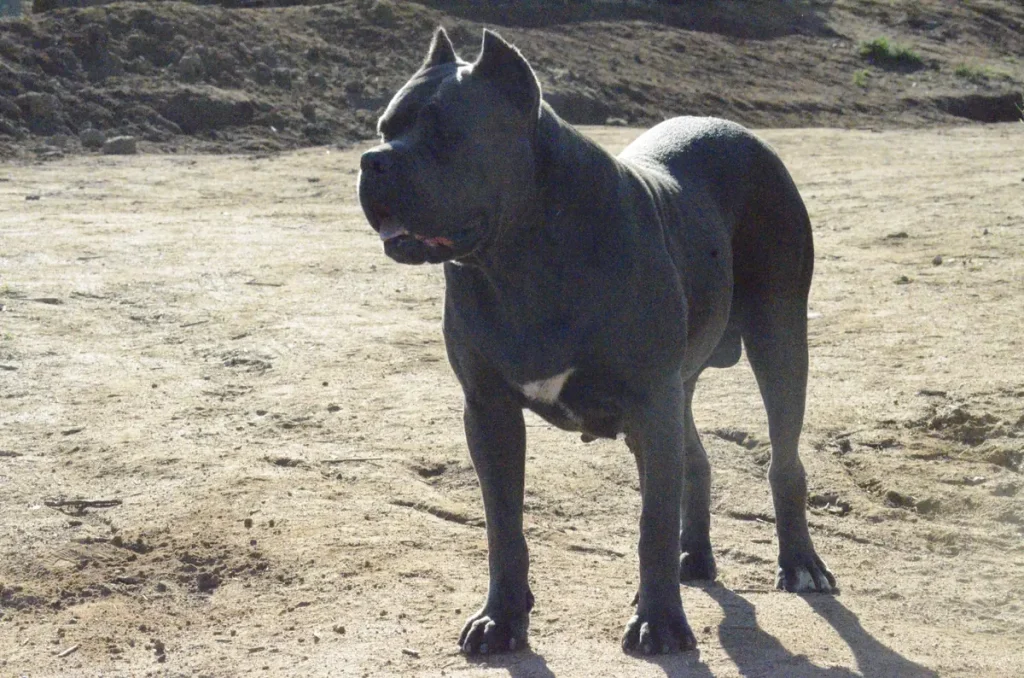
“King Corso” is not a dog breed. There is no King Corso standard, no King Corso registry and no King Corso that is bigger, rarer or different from a Cane Corso. The breed is the Cane Corso. “King Corso” is a name, and in our case, it’s the name of our kennel.
We’re King Corso Kennel, a family Cane Corso breeder on an 80-acre ranch in Jamul, in San Diego County. Since people search “King Corso vs Cane Corso,” we’d rather explain this honestly than let the name cause confusion. Below: where the name comes from, why “king size” claims don’t hold up, and what you should check instead of a name.
Short answer: A “King Corso” is a Cane Corso. “King Corso” is the name of our kennel. It is not a breed, a registry or a title, and a seller could just as easily use “king” as a sales word. Judge any puppy by the breed standard, the parents’ health results and their temperament, not by the label.
- A “King Corso” is simply a Cane Corso if it comes from Cane Corso parents, and the seller can show you those parents and their health records.
- Be cautious if a seller says “King Corso” means a separate, larger or “upgraded” breed, or charges extra for that name rather than for documented health and temperament.
| Cane Corso | “King Corso” | |
|---|---|---|
| What it is | A recognized dog breed | A name: a kennel name or a sales label |
| Who stands behind it | Kennel clubs with written standards (AKC, FCI) | Nobody. It is a name a kennel or seller chooses |
| AKC status | Recognized 2010, Working Group | Not on the AKC breed list |
| FCI status | Standard No. 343, “Cane Corso Italiano” | No standard |
| Country of origin | Italy | Not applicable |
| Height | Males 25–27.5 in; females 23.5–26 in (AKC) | Same as Cane Corso |
| Weight | “Proportionate to height” (AKC); males 45–50 kg, females 40–45 kg (FCI) | Same as Cane Corso |
| Life expectancy | 9–12 years (AKC) | Same as Cane Corso |
| Colors | Black, gray, fawn, red, and brindled versions (AKC) | Same as Cane Corso |
| Health tests | Hips, elbows, patellas, cardiac; DSRA and NCL1 DNA tests (AKC) | Same as Cane Corso |
| Is “bigger” a real trait? | Oversize is a severe fault in the FCI standard | No standard supports a larger “king” type |
Sources: AKC Cane Corso breed page, breed standard and breed directory; FCI Standard No. 343 (2023).
Is King Corso a different breed from the Cane Corso?
No. The only breed involved is the Cane Corso. The American Kennel Club recognizes the “Cane Corso” in its Working Group, since 2010. The FCI (Fédération Cynologique Internationale), whose standard lists Italy as the breed’s country of origin, calls it the “Cane Corso Italiano (Italian Cane Corso).” Neither has a “King Corso,” and the AKC’s full breed directory doesn’t list one either.
So when you see “King Corso” on a website, a puppy listing or a dog’s name, read it as a name attached to a Cane Corso. The dog underneath is judged against the same Cane Corso standard as any other.
Why do some Cane Corsos have “King Corso” in their name?
Because breeders often put their kennel’s name into the names of dogs they breed or own. It works like a family surname for a breeding program. It is a naming habit, not a breed label.
That’s why some of our dogs carry it. Yunis King Corso, Roxy II King Corso, Kayla King Corso and Gloria King Corso are Cane Corsos. “King Corso” in their names tells you which program they belong to, not what breed they are. Queen Corso, one of our females from Serbia, is a Cane Corso too. So is Giulio Caesar, who doesn’t carry the kennel name at all.
To be plain about what the name is not: “King Corso” is the name our family gave the kennel. It is not a breed, not a registry and not a title, and a dog’s name is not a registration certificate. The AKC runs a separate program in which breeders can apply to register a kennel name, which it describes as “very much like copyrighting a name for one’s sole use”. Don’t read any dog’s name, ours included, as proof of that kind of registration. If it matters to you, ask the breeder to show you the paperwork.
A seller could also use “king” differently, as a word that sounds bigger or more impressive. That’s marketing. It tells you nothing about the dog.
Who is King Corso Kennel?
We’re a family-owned Cane Corso breeder run by Aston and his sons on an 80-acre ranch at 3983 Beaver Hollow Rd in Jamul, California. Aston says he’s “proud to be recognized among California’s leading Cane Corso breeders,” and we’re rated 5.0 on Google.
The program started with a bad experience. In 2014 Aston bought a male and a female Cane Corso from a backyard breeder to protect his property. The male developed hip dysplasia and had trouble getting up. The female had cherry eye, joint problems and knee dysplasia. The surgeries cost more than the dogs, and both needed long-term pain management. He went on to study genetics and pedigrees and built a program on European bloodlines, with health, structure and temperament first.
Today our breeding dogs are Giulio Caesar (also called Julius Caesar), from a grand champion lineage in Bosnia with original Italian genetics; Yunis King Corso, imported from Serbia; Queen Corso, imported from Serbia; Roxy II King Corso, from an Argentinian bloodline; Kayla King Corso, bred here; and Gloria King Corso, a black female. Caesar, Yunis, Queen, Roxy II and Kayla are all hip and elbow scored HD-A / ED-0. Our pairings are Caesar x Queen, Caesar x Roxy II, and Yunis x Kayla. See them on our dogs page and read our story.
Is a “King Corso” bigger than a regular Cane Corso?
No. No standard describes a larger “king” type, and the breed’s own standards push against oversized dogs. The AKC standard sets males at 25 to 27.5 inches and females at 23.5 to 26 inches, with weight “proportionate to height.” The FCI standard sets males at 64 to 68 cm and 45 to 50 kg, females at 60 to 64 cm and 40 to 45 kg, with a 2 cm tolerance, and lists “over-or under size” as a severe fault.
The AKC does note that Corsi are “often weighing more than 100 pounds,” which is in line with the FCI range for a big male. What you won’t find in any standard is a separate giant version. If a puppy is sold as “king size,” “XXL” or “giant,” ask to see both parents and their hip and elbow results, because size beyond the standard is a fault, not a feature. We cover the biggest weight claim in Can a Cane Corso weigh 200 pounds?.
How long does a King Corso live?
The same as any Cane Corso: the AKC lists the breed’s life expectancy as 9 to 12 years. A kennel name doesn’t change that, and neither does any other label in an ad.
Health-tested parents are the part a breeder controls, which is why our program is built around them. Our full guide to Cane Corso lifespan covers what tends to shorten or extend it. Ask your vet about your own dog.
What health problems do King Corsos have?
The same ones any Cane Corso can have, because they are Cane Corsos. The AKC says responsible breeders screen for hip dysplasia, idiopathic epilepsy, demodex mange and eyelid abnormalities. It also warns that large, deep-chested breeds are susceptible to bloat, “a sudden, life-threatening stomach condition.”
The AKC’s recommended tests for the breed are a hip evaluation, elbow evaluation, patella evaluation, cardiac exam, and DNA tests for Dental Skeletal Retinal Atrophy (DSRA) and Neuronal Ceroid Lipofuscinosis (NCL1). Aston’s first two dogs showed what skipping this costs: hip dysplasia in one, cherry eye and knee dysplasia in the other. Our health testing page explains what we screen, and the Cane Corso health problems guide covers signs to watch for.
What does the name “Cane Corso” actually mean?
“Cane” is Italian for dog, from the Latin canis. “Corso” is older and its meaning is described two ways. The AKC says the breed’s name “roughly translates from the Latin as ‘bodyguard dog.'” The FCI standard says the name “derives from the Latin ‘cohors’, which means ‘protector, guardian of the farmyard’.”
Either way, the name describes a job: guarding. The AKC gives the pronunciation as “KAH-neh-KOR-soh,” and the plural as “Cani Corsi.” There’s nothing royal in it, which is one more reason “King” can only be a name added on top. For the other common naming mix-up, see Cane Corso vs Italian Mastiff.
Where did the Cane Corso come from?
Southern Italy, from Roman-era guardian dogs. The AKC says Roman legions brought Molossian dogs back to Italy and bred them with native Italian dogs, producing the Corso and its larger relative, the Neapolitan Mastiff. The FCI standard says that in the recent past the breed survived mainly in the province of Apulia and nearby regions of southern Italy.
According to the AKC, a breed society formed in Italy in 1983, the first Corso arrived in America in 1988, the breed entered the AKC’s Foundation Stock Service in 1996, and it gained full AKC recognition in 2010. That’s the history of every Cane Corso, including ours. Bloodline differences, such as European versus American lines, are a separate topic covered in European vs American Cane Corso.
How much does a King Corso cost?
It costs what a Cane Corso costs, and a name alone shouldn’t add to the price. Our price page notes that Cane Corso puppies from reputable breeders typically run $2,500 to $5,000 or more. That’s a market range, not our price; ask us about the litter you’re interested in.
What should raise or lower a price is evidence: health scores on both parents, the parents’ temperament, how the puppies are raised and what support you get afterward. For a full breakdown, read Cane Corso price in California. At our kennel, a $500 reservation holds a puppy, and we offer interest-free financing with no finance charges.
What should you look for instead of a name?
Look at the parents, their records and how the breeder answers questions. A name, ours included, is not evidence. Here’s what is:
- Hip and elbow results for both parents. Ask to see the actual scores, such as FCI HD and ED grades or OFA results. Our explainer FCI vs OFA hip and elbow scores shows how to read them.
- The other AKC-recommended tests. Patellas, cardiac exam, and DSRA and NCL1 DNA tests. If a breeder hasn’t done one, ask why.
- Meeting the parents. A Corso’s adult temperament is the best clue to your puppy’s. You’re looking for a steady, confident adult, not a fearful or aggressive one. The FCI disqualifies “aggressive or overly shy dogs.”
- A correct dog, not an extreme one. Weight in proportion to height, sound movement, and colors the standards accept.
- Visits and openness. You should be able to see where puppies are raised. We welcome visits from around 4 weeks old.
- Straight answers on paperwork. Ask what registration, contract and health guarantee come with a puppy, and get them in writing.
For more, see 9 Cane Corso breeder red flags.
Should you choose a puppy from a kennel called “King Corso”?
Choose any breeder, us included, on evidence rather than the name. A kennel name is only as good as the dogs behind it, and a name can be copied by anyone. Health results and the dogs themselves can’t. If you want a Corso from us, judge us the same way you’d judge anyone: look at our dogs’ HD-A / ED-0 scores, meet the parents, see the puppies, and ask hard questions.
If you’d like to do that, see available puppies or contact us at (619) 370-5227 to plan a visit to the ranch. Recent litters have included blue and black puppies, and we’ve placed a puppy as far away as Texas.
Comparing breeds? See all our Cane Corso comparisons side by side.
Frequently asked questions
Is “King Corso” a breed recognized by the AKC?
No. The AKC recognizes the Cane Corso, in its Working Group since 2010, and its breed directory has no “King Corso.” The FCI calls the breed “Cane Corso Italiano.” A dog described as a King Corso should be a Cane Corso, and it’s judged against the same standard. If a seller claims otherwise, ask which registry recognizes it.
Is “King Corso” the same as “Kane Corso”?
Not quite. “Kane Corso” is just a common misspelling of Cane Corso, based on how the name sounds. “King Corso” is a kennel name or a sales label. Both point back to the same breed, the Cane Corso, which the AKC pronounces “KAH-neh-KOR-soh.” Our Italian Mastiff article explains the other names people use.
Is there a “king size” or “giant” Cane Corso line?
Not according to any breed standard. The AKC asks for weight in proportion to height, and the FCI standard lists over- or under-size as a severe fault. Big males can exceed 100 pounds, but a puppy marketed as “giant” or “XXL” is being sold on a trait the standards count against a dog. Ask to see both parents and their hip and elbow scores.
Do King Corso Kennel puppies come with registration papers?
Ask us. We’ll go over registration, the contract and what’s included for the specific litter you reserve in, and you should get those details in writing. The kennel name itself is not a registration and not a breed. With any breeder, confirm registration details before you pay a deposit, and remember that papers record parentage; they don’t prove health.
Where is King Corso Kennel located?
We’re on an 80-acre ranch at 3983 Beaver Hollow Rd, Jamul, CA 91935, in San Diego County. Call (619) 370-5227 to arrange a visit. Families can see the litter from around 4 weeks old and meet the parents. One of our puppies has gone to a home as far away as Texas.
How do I reserve a puppy from King Corso Kennel?
A $500 reservation holds a puppy. We also offer interest-free financing with no finance charges if you’d like to spread the cost. Call (619) 370-5227 or use our contact page, and we’ll tell you about current and upcoming litters, the parents in each pairing, and what comes with a puppy from that litter.
Why is your kennel called King Corso if it’s not a breed?
It’s our program’s name, the same way many breeders name their kennels. You’ll see it in our dogs’ names, like Yunis King Corso and Kayla King Corso. It is not a separate breed, and we don’t present it as one. Every dog in our program is a Cane Corso, and we’d rather you judge us by our dogs’ health scores and temperaments than by the name on the gate.