
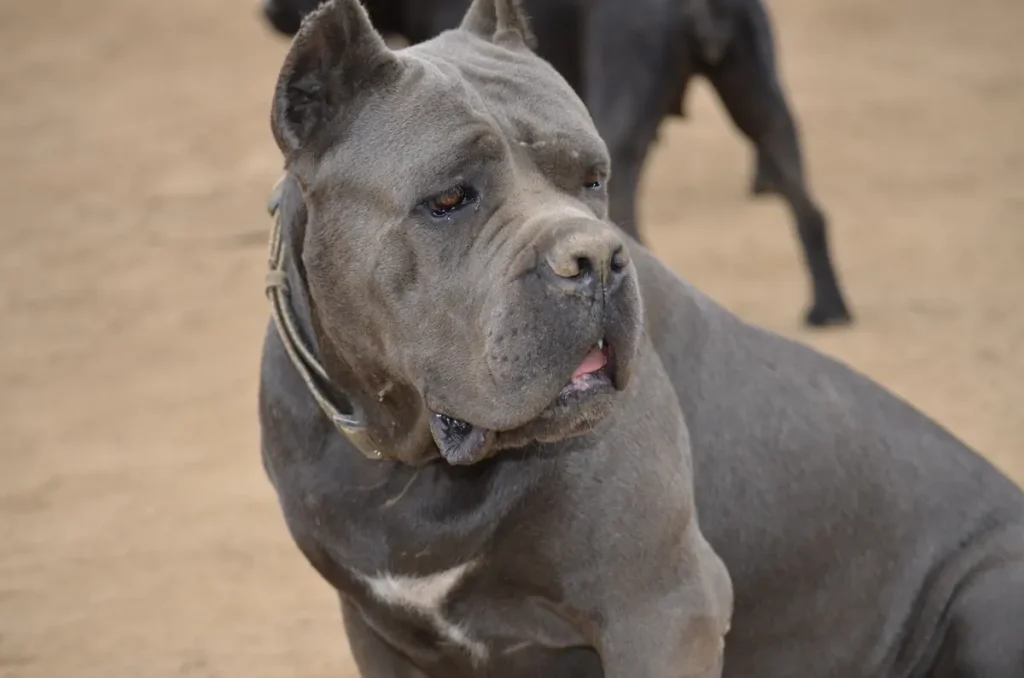
Most Cane Corsos live about 9 to 12 years. That is the range the American Kennel Club gives, and the only published lifespan study of the breed found a median of just over 9 years. Some dogs live well past that and some die much younger. This page covers what the numbers actually say, where they come from, and the few things owners and breeders can do that make a real difference.
We are a breeder, so we have a reason to make our breed sound long-lived. We have tried hard not to. Where the evidence is thin, we say so.
How long do Cane Corsos live?
A Cane Corso typically lives 9 to 12 years. The AKC Cane Corso breed page lists a life expectancy of 9 to 12 years. A 2017 study of 232 Cane Corsos from 25 countries found a median lifespan of 9.29 years, meaning half the dogs in the study died before that age and half after.
The middle half of the dogs in that study died between about 7 and 11 years of age. So a Corso reaching 10 or 11 is doing well, and one reaching 12 or more is doing very well. At the other end, a quarter of the dogs in the study had died by about 7.
What does the research say about Cane Corso lifespan?
There is one peer-reviewed lifespan study specific to the breed, and it is worth knowing both what it found and its limits. The paper, “Longevity of Cane Corso Italiano dog breed and its relationship with hair colour” by Korec and colleagues, was published in the Open Veterinary Journal in 2017.
- How the data was collected: the authors asked more than 600 kennels and owners around the world to fill in a questionnaire, and obtained data on 232 dogs that had died, from 73 kennels and owners in 25 countries.
- What was excluded: dogs whose stated cause of death was poisoning or an accident.
- Overall result: a median lifespan of 9.29 years, with an interquartile range of 6.98 to 11.12 years.
- Full range: the youngest dog in the data died at 0.42 years and the oldest at 18.00 years.
The limits matter. The ages are self-reported by the kennels and owners who chose to reply, 73 out of more than 600 asked, and the paper does not describe any check against veterinary records. People who answer a survey like this may not be typical of all owners. The study counts only dogs that had already died, and it leaves out deaths from poisoning and accidents, so the median describes dogs that died of other causes. The paper collected causes of death but does not report them. The sample is modest, and once it is split by color some groups have only a few dozen dogs or fewer. Treat 9.29 years as the best published estimate for the breed, not a forecast for your dog.
For context, the authors note that the Cane Corso is a young breed in registry terms. It was fully recognized by the FCI, the international kennel federation, in 2007, so long-term health records are still building up.
Do male or female Cane Corsos live longer?
In the one study we have, there was essentially no difference. The median lifespan was 9.25 years for males and 9.33 years for females, and the authors’ statistical test did not find that females outlived males. Sex was recorded for 227 of the 232 dogs: 114 males and 113 females.
So sex should not be your deciding factor for longevity. Males are generally larger, and size does affect lifespan across dog breeds, but within this breed the study did not pick up a meaningful gap. If you are choosing between a male and a female for other reasons, our male vs female Cane Corso guide covers temperament and practical differences.
Does coat color affect how long a Cane Corso lives?
The study found brindle dogs had the longest median lifespans, but the authors themselves describe this as a possible relationship that needs more research, so do not choose a puppy by color for longevity. Here are the medians they reported:
| Color | Median lifespan (years) | Dogs in study |
|---|---|---|
| Black brindle | 10.30 | 35 |
| Brindle | 10.13 | 38 |
| Grey brindle | 9.84 | 26 |
| Fawn | 9.01 | 27 |
| Black | 9.00 | 62 |
| Grey | 9.00 | 31 |
| Other colors | 8.09 | 13 |
| All dogs | 9.29 | 232 |
Source: Korec E. et al., Open Veterinary Journal, 2017, Table 1.
Notice how small the groups are. Thirteen dogs in “other colors” is not enough to say anything firm about those colors. The spreads also overlap heavily: the middle half of black brindle dogs died between 8.33 and 13.00 years, and the middle half of black dogs between 6.14 and 11.00. The paper lists analysis of variance among its methods but gives no result or p-value for the gaps between colors, so it does not show they are bigger than chance. The authors wrote that the pattern “may suggest a relationship between brindle status” and longevity, and that examining it would be the aim of future work. We have not found a follow-up study.
What this means for you: “blue Cane Corso lifespan” or “black Cane Corso lifespan” searches will turn up confident numbers, but there is no strong evidence that a grey (often called blue) or black Corso will live a different length of time from any other color. The parents’ health and how the dog is kept matter far more. Our Cane Corso colors compared page covers what each color is and which ones the breed standards accept.
Can a Cane Corso live 15 years?
It can happen, but it is rare, and no one can promise it. The oldest dog in the lifespan study died at 18, so very long lives do occur. But three quarters of the dogs in that study had died by about 11, so planning for a 15-year dog would be setting yourself up for disappointment.
A fairer way to think about it: plan for 9 to 12 good years, and treat anything beyond that as a gift that good genes, a lean body and attentive vet care helped earn.
Why do Cane Corsos live shorter lives than small dogs?
Size is the main reason. Across dog breeds, bigger dogs tend to die younger. The Korec paper summarizes earlier research: a UK health survey found the median age at death was significantly higher in small breeds than in large or giant breeds, and another study found a negative correlation between height and longevity and between weight and longevity.
The Cane Corso is a large breed. The AKC lists males at 25 to 27.5 inches and females at 23.5 to 26 inches at the shoulder, with weight “proportionate to height.” Bigger is not better for the joints either. VCA Animal Hospitals says large-breed puppies should be kept at a normal, lean weight during growth, “not overfed or encouraged to grow big,” and that excess weight puts undue stress on the hip joints. That is an argument against chasing extra size. If you have seen advertisements for 200-pound Corsos, read can a Cane Corso weigh 200 pounds?
What shortens a Cane Corso’s life?
The threats owners and breeders can do something about are bloat, excess weight, and inherited problems that go unscreened in the parents. There is no published cause-of-death study for this breed, so we cannot rank them by percentage. Here is what the veterinary sources do tell us.
Bloat (gastric dilatation-volvulus)
The AKC notes that large and deep-chested breeds are susceptible to bloat, “a sudden, life-threatening stomach condition.” The American College of Veterinary Surgeons calls GDV a “rapidly progressive life-threatening condition of dogs that requires immediate medical attention,” lists a deep chest as a risk factor, and reports mortality of approximately 15%. Early signs are often linked to abdominal pain. If you suspect bloat, go to a vet immediately; do not wait to see if it passes.
Excess weight
Weight is the factor owners control most. In a study of 48 Labrador Retrievers fed in pairs from 8 weeks of age until death, the dogs fed 25% less than their pair-mates had a longer median lifespan and a delayed onset of chronic disease. Labradors are not Corsos, and one study of 48 dogs does not settle the question for every breed, but it is the most direct evidence there is that keeping a dog lean matters. Ask your vet what a healthy weight looks like for your dog.
Joint disease
We have no figures on how hip and elbow dysplasia affect lifespan in this breed. What the veterinary sources do say is that both are inherited: VCA describes hip dysplasia as a genetic disease whose usual signs are weakness and pain in the hind legs, and OFA describes elbow dysplasia as an inherited disease. A dog in pain is harder to keep active and lean. Screening the parents is the part of this a breeder controls.
Age-related disease
In dogs generally, research cited in the Korec paper found that young dogs most often died from gastrointestinal and infectious causes, while older dogs more often died from neurological disease and cancer. We do not have breed-specific figures for the Corso. Ask your vet how often an older Corso should be checked.
For the full list of conditions to know about, see Cane Corso health problems.
How can you help a Cane Corso live longer?
Keep the dog lean, know the signs of bloat, start with health-tested parents, and see your vet regularly. None of these guarantees a long life, but they are the steps the evidence above points to.
- Keep your dog lean for life. Of everything on this list, it is the one with direct feeding-study evidence in dogs. The Korec paper also cites research on Labradors in which lifelong lean body mass was a key factor in exceptional lifespan. Ask your vet to show you how to check your dog’s body condition at home.
- Feed a growing puppy for steady growth, not maximum size. OFA notes that caloric intake and exercise can affect how severe hip dysplasia becomes. Our best food for Cane Corso puppies and size and growth guide cover this.
- Learn the signs of bloat, and ask your vet about gastropexy. ACVS says many veterinary surgeons recommend preventive gastropexy for at-risk breeds, and that it can often be done at the same time as a spay or neuter. Whether it suits your dog is a conversation for your vet.
- Exercise sensibly at every age. What is sensible changes as a dog grows, so ask your vet what suits your dog’s age. Our exercise needs guide goes by age, and Cane Corso hot weather covers summer in inland San Diego.
- Look after teeth and ears. The AKC recommends checking a Corso’s ears regularly for infection and brushing the teeth often with a dog toothpaste.
- Start with tested parents. The Korec authors suggest appropriate breeding as a possible way to lengthen lifespan in the breed. That is a hypothesis, not proof, but screening for inherited disease is the part of longevity a breeder controls.
Does a health-tested breeder mean a longer-lived dog?
Not guaranteed, and nobody has studied it directly in Cane Corsos. What testing does is lower the odds of inherited joint problems such as hip and elbow dysplasia. A dog that moves comfortably is easier to keep active and lean.
Aston learned this the hard way. In 2014 he bought a male and a female from a backyard breeder. The male developed hip dysplasia and had trouble getting up, and the female had cherry eye, joint problems and knee dysplasia. The surgeries cost more than the dogs, and long-term pain management followed. Those years are why our breeding dogs are hip and elbow scored, and why we built our program on European bloodlines with health, structure and temperament first.
What do we do at King Corso Kennel?
Our breeding dogs Giulio Caesar, Yunis, Queen, Roxy II and Kayla are all hip and elbow scored HD-A / ED-0. Caesar comes from a grand champion lineage in Bosnia with original Italian genetics; Yunis and Queen were imported from Serbia; Roxy II is from an Argentinian bloodline; and Kayla was bred here. You can meet them on our dogs page and read how we breed for health on our health testing page.
We cannot promise any puppy a 12-year life, and you should be wary of anyone who does. What you can do is meet the parents and ask us about their hip and elbow scores. Families can visit the litter from around 4 weeks old on our ranch in Jamul. See current and upcoming litters on our puppies page, or call (619) 370-5227.
Frequently asked questions
What is the average lifespan of a Cane Corso?
About 9 to 12 years. The AKC lists 9 to 12 years, and the only published breed study, covering 232 Cane Corsos from 25 countries, found a median of 9.29 years. Half of those dogs died between roughly 7 and 11 years old. Individual dogs vary widely, from puppies lost young to one dog that reached 18.
What is the oldest a Cane Corso has lived?
We do not know of any verified record. The oldest dog in the 2017 lifespan study died at 18 years, but that figure is self-reported by the owner or kennel and not independently confirmed. Claims of record ages online are rarely documented. Plan for 9 to 12 years and be grateful for more.
Is a 9-year-old Cane Corso old?
By the numbers we have, yes. The breed’s median lifespan in the only published study was 9.29 years, so by that age your dog has outlived about half of the dogs in that sample. Ask your vet how often an older Corso should be checked, keep a close watch on weight, and adjust exercise to what your dog is comfortable with.
How long do Cane Corso mixes live?
There is no published data on Cane Corso crosses, so any specific number you see online is a guess. In general research cited in the Korec paper, crossbred dogs lived slightly longer than purebreds on average, but a mix with another large or giant breed is still a large dog, and the research that paper cites links larger size with shorter lifespan.
Does neutering affect Cane Corso lifespan?
There is no Cane Corso-specific study that answers this, so be wary of anyone who quotes a number. Whether and when to spay or neuter a large-breed dog involves several health considerations that are best weighed for the individual dog. Ask your vet to talk through the options early in your puppy’s first year, so you are not deciding in a rush.
Do blue Cane Corsos have shorter lives?
There is no strong evidence that they do. In the 2017 study, grey dogs, which many people call blue, had a median lifespan of 9.00 years, the same as black dogs and close to the overall median of 9.29. The study had only 31 grey dogs, so small differences mean little. Parent health matters far more than color.
What do Cane Corsos usually die from?
No study has reported causes of death for this breed specifically. What we know comes from veterinary sources on large, deep-chested dogs, which are at risk of bloat, and from general research in which older dogs more often died of cancer and neurological disease. Your vet is the best guide to the risks for your own dog as it ages.