
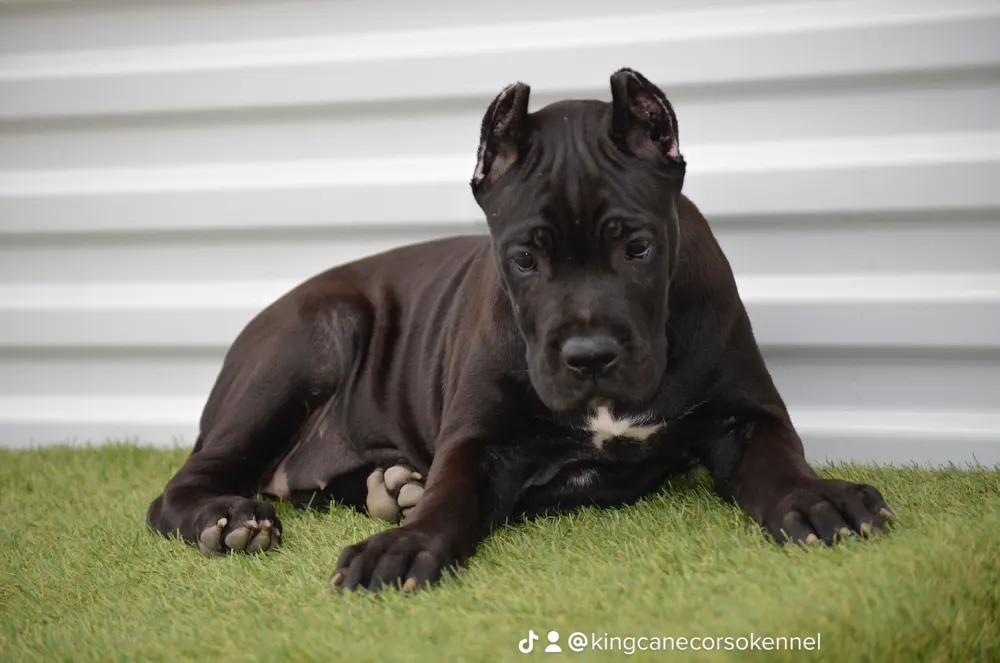
If you’ve seen the same dog called a Cane Corso, an Italian Mastiff, a Cane Corso Mastiff, an Italian Corso and a “Kane Corso,” you’re not imagining it. In most cases those are all one breed: the Cane Corso. The real mix-up is with Italy’s other mastiff, the Neapolitan Mastiff, which is a different breed with a very different body and lifestyle.
This page sorts out the names first, then compares the two Italian mastiff breeds side by side, with sources for every figure.
Short answer: “Italian Mastiff” is a popular nickname for the Cane Corso, whose official FCI name is “Cane Corso Italiano.” The other Italian mastiff breed is the Neapolitan Mastiff (Mastino Napoletano): heavier, wrinkled, lower-energy and shorter-lived.
- Choose a Cane Corso if you want an athletic, trainable guardian that can walk, hike and work with you, and you’re ready for daily exercise and training.
- Choose a Neapolitan Mastiff if you want a calmer, heavier, very low-energy house guardian, and you can live with heavy drool, skin folds that need care and a shorter expected lifespan.
| Cane Corso (“Italian Mastiff”) | Neapolitan Mastiff | |
|---|---|---|
| Official names | AKC: Cane Corso. FCI: Cane Corso Italiano | AKC: Neapolitan Mastiff. FCI and Italian: Mastino Napoletano |
| AKC recognition | 2010, Working Group | 2004, Working Group |
| Height | Males 25–27.5 in; females 23.5–26 in | Males 26–31 in; females 24–29 in |
| Weight | “Proportionate to height” (AKC); males 45–50 kg, females 40–45 kg (FCI) | About 150 lb males, 110 lb females (AKC); males 60–70 kg, females 50–60 kg (FCI) |
| Life expectancy | 9–12 years | 7–9 years |
| Body type | Muscular, athletic, “slightly longer than tall” (FCI) | “Large, heavy and massive,” body 15% longer than tall (FCI) |
| Skin | Fairly thick, close fitting; no evident wrinkles on the head (FCI) | Loose skin with many folds, wrinkles and a double dewlap |
| Drooling (AKC 1–5) | 3 | 5 |
| Energy (AKC 1–5) | 4 | 2 |
| Trainability (AKC 1–5) | 4 | 3 |
| Ears (FCI) | Un-cropped (AKC allows cropped or uncropped) | Natural |
| Recommended tests (AKC) | Hips, elbows, patellas, cardiac; DSRA and NCL1 DNA | Hips, elbows, cardiac, eye exam |
| Region of origin | Southern Italy, especially Apulia | Naples and the area around Vesuvius |
Sources: AKC Cane Corso and Neapolitan Mastiff breed pages and the AKC Cane Corso standard; FCI Standard No. 343 (Cane Corso Italiano) and No. 197 (Mastino Napoletano).
Is a Cane Corso an Italian Mastiff?
Yes, in everyday use “Italian Mastiff” almost always means the Cane Corso. It’s a description, not a registry name. The AKC calls the breed “Cane Corso” and describes it as “a mastiff type breed… better known in his native Italy.” The FCI, whose standard lists Italy as the country of origin, registers it as “Cane Corso Italiano (Italian Cane Corso)” in its Molossian, mastiff-type section.
So a “Cane Corso Italian Mastiff” or “Cane Corso Mastiff” is not a cross. It’s the Cane Corso described by type and country. The AKC’s breed directory doesn’t list a breed called “Italian Mastiff” at all. If someone selling an “Italian Mastiff” can’t tell you which breed and registry they mean, ask.
The one exception: some people use “Italian mastiff” loosely for the Neapolitan Mastiff, the other Italian mastiff breed. We compare the two below. Our Italian Mastiff puppy guide covers raising a Corso puppy.
What does “Cane Corso” mean in Italian?
“Cane” means dog in Italian, from the Latin canis. “Corso” has two explanations in official sources. The AKC says the breed’s name “roughly translates from the Latin as ‘bodyguard dog.'” The FCI standard says it “derives from the Latin ‘cohors’, which means ‘protector, guardian of the farmyard’.”
Both point to the same job. The FCI describes the Corso as a “guardian of property, family and livestock” that was once used for herding cattle and hunting big game. The AKC’s standard says it “has always been a property watchdog and hunter of difficult game such as the wild boar.”
Is it Cane Corso, Kane Corso or Italian Corso?
The correct name is Cane Corso. “Kane Corso” is a phonetic misspelling, and “Italian Corso” is an informal blend of the breed name and its country; the nearest official name is the FCI’s Cane Corso Italiano. The AKC gives the pronunciation as “KAH-neh-KOR-soh,” and its breed page offers “Connie Corso” as an informal sound-alike.
The AKC lists the plural as “Cani Corsi” and the nickname as “Corso.” In English, “Cane Corsos” is common too; you’ll see both on our site. “King Corso” is something else again: a kennel name, not a breed. We explain that in King Corso vs Cane Corso.
Is the Neapolitan Mastiff also an Italian mastiff?
Yes. The Neapolitan Mastiff is a separate Italian breed, called “mastino napoletano” in Italian according to the AKC. It’s the one people usually picture when they say “mastiff with lots of wrinkles.” The FCI standard traces it to the great Roman mastiff and says it survived for centuries around Vesuvius and Naples, with the modern breed “re-selected since 1947.”
The two breeds are relatives. The AKC says Roman legions brought Molossian dogs to Italy and bred them with native Italian breeds, creating the Corso and its larger relative, the Neapolitan Mastiff. Same ancestry, different jobs: the Corso stayed an agile farm guardian and hunter, while the Mastino was bred for a huge frame and an intimidating look. For the full comparison, see Cane Corso vs Neapolitan Mastiff.
How do the Cane Corso and Neapolitan Mastiff differ in size?
The Neapolitan is taller at the top of its range and much heavier. The AKC lists Neapolitan males at 26 to 31 inches and about 150 pounds, and females at 24 to 29 inches and about 110 pounds. The FCI gives Neapolitan males 60 to 70 kg and females 50 to 60 kg.
The Cane Corso is built lighter and more athletic. The AKC standard puts males at 25 to 27.5 inches and females at 23.5 to 26 inches, with weight “proportionate to height,” and notes Corsi often weigh more than 100 pounds. The FCI gives Corso males 45 to 50 kg and females 40 to 45 kg.
The shapes differ as much as the numbers. The FCI calls the Neapolitan “large, heavy and massive” with “ample skin with wrinkles and folds.” It describes the Corso as “robust and sturdy… nevertheless with some elegance,” with lean, powerful muscles. Our Cane Corso size and growth guide covers how Corsos develop.
How do they differ in temperament and energy?
Both are guardians, but the Corso is far more active. The AKC rates Cane Corso energy 4 out of 5 and Neapolitan energy 2 out of 5. It recommends at least a mile of brisk walking or running each morning and evening for a Corso, which “is happiest when given a job to do.”
The AKC describes the Neapolitan as “wary with strangers” and “sweet, placid, and steady among loved ones.” It rates both breeds 5 out of 5 for protective nature. The Corso standard calls it “intelligent” and “easily trained,” and the AKC rates its trainability 4 out of 5, against 3 for the Neapolitan.
In daily life, a Corso is a dog you can hike, train and do dog sports with. The AKC lists agility, obedience, dock diving, protection sport and tracking. A Neapolitan is more of a calm, imposing presence at home. Read more about the Cane Corso temperament.
Which lives longer, the Cane Corso or the Neapolitan Mastiff?
The Cane Corso, on average. The AKC lists Cane Corso life expectancy at 9 to 12 years and Neapolitan Mastiff life expectancy at 7 to 9 years.
Those are breed-wide figures, not a promise for any one dog. See our Cane Corso lifespan guide, and ask your vet about your own dog.
What health problems should you screen for in each?
For the Cane Corso, the AKC’s recommended tests are hip, elbow and patella evaluations, a cardiac exam, and DNA tests for Dental Skeletal Retinal Atrophy (DSRA) and Neuronal Ceroid Lipofuscinosis (NCL1). The AKC adds that responsible breeders screen for hip dysplasia, idiopathic epilepsy, demodex mange and eyelid abnormalities.
For the Neapolitan Mastiff, the AKC lists hip and elbow evaluations, a cardiac exam and an ophthalmologist exam. It says “cherry eye” often occurs, usually without permanent damage, and that, as with all breeds, the Mastino can develop hip dysplasia.
Both breeds are deep-chested and at risk of bloat, a sudden, life-threatening stomach condition. Learn the signs and ask your vet what to do. Our health testing page shows how we screen our dogs, and our guide to Cane Corso hip dysplasia explains why hips matter so much.
Where did the Cane Corso come from?
From Italy’s Roman-era Molossian dogs, kept alive in the south. The AKC says that after the Western Roman Empire fell, Corsi worked as boar hunters, farm dogs, livestock drovers and farmstead guardians. By the mid-20th century “the breed was all but extinct,” surviving in Italy’s back country. The FCI says it was found mainly in the province of Apulia and neighboring regions of southern Italy.
Italian fanciers began reviving the breed in the 1970s, and the Society of Cane Corso Lovers formed in 1983. The AKC says the first Corso arrived in America in 1988, the breed entered the AKC Foundation Stock Service in 1996, and it became a fully recognized AKC breed in 2010. Its AKC standard was approved in October 2009 and took effect in June 2010.
Do Italian and American standards for the Cane Corso differ?
A little, mainly on ears and size details. The FCI standard says “ears are un-cropped.” The AKC standard says ears “may be cropped or uncropped.” The AKC gives height in inches with weight proportionate to height, while the FCI gives exact weight ranges and calls over- or under-size a severe fault.
Colors overlap. The AKC accepts black, shades of gray, shades of fawn and red, with brindling allowed on all of them. The FCI lists black, lead-grey, slate-grey and light grey, light and dark fawn, stag red, dark wheat, and black and grey brindle. If you’re weighing European and American lines, see European vs American Cane Corso and our cropped vs natural ears guide.
Cane Corso or Neapolitan Mastiff: which Italian mastiff should you choose?
Choose the Neapolitan Mastiff if you want a calm, very heavy house guardian, don’t want a running or hiking partner, and accept heavy drool (the AKC rates it 5 out of 5), skin fold care and a 7-to-9-year life expectancy. It suits a quieter household that values presence over activity.
Choose the Cane Corso if you want a trainable, athletic guardian that will exercise and work with you. It’s the better fit for an active family, but the wrong one if you can’t give it daily exercise and lifelong training. For the bigger picture, our Cane Corso breed guide covers daily life with the breed.
How does King Corso Kennel breed its Cane Corsos?
We focus on health, correct structure and stable temperament, built on European bloodlines. Our male Giulio Caesar comes from a grand champion lineage in Bosnia with original Italian genetics, and Aston describes him as very lovable, very trainable and very obedient. Yunis King Corso and Queen Corso were imported from Serbia, Roxy II King Corso is from an Argentinian bloodline, and Kayla King Corso was bred here. All five are hip and elbow scored HD-A / ED-0. Meet them on our dogs page.
Aston started breeding after two backyard-bred Corsos he bought in 2014 developed hip dysplasia, cherry eye and knee dysplasia, with surgeries that cost more than the dogs. Families can visit the litter from around 4 weeks old and meet the parents at our ranch in Jamul. A $500 reservation holds a puppy, and interest-free financing is available. See available puppies or call (619) 370-5227.
Comparing breeds? See all our Cane Corso comparisons side by side.
Frequently asked questions
Is “Italian Mastiff” an official breed name?
Not with the AKC. Its breed directory has the Cane Corso and the Neapolitan Mastiff, but no breed called “Italian Mastiff.” The FCI uses “Cane Corso Italiano” and “Mastino Napoletano.” “Italian Mastiff” is an everyday description, most often used for the Cane Corso. When you see it in an ad, confirm which breed and registry the seller means.
Is a Cane Corso part Neapolitan Mastiff?
No. They share ancient Roman ancestry, which is why the AKC calls the Neapolitan the Corso’s “larger relative,” but today they’re two separate breeds with separate standards. A dog that is part Corso and part Neapolitan is a mix, not either breed, and you can’t predict its size, drool or energy from the parents’ labels.
Do Italian Mastiffs drool a lot?
It depends which one. The AKC rates the Cane Corso 3 out of 5 for drooling, so expect some. The Neapolitan Mastiff rates 5 out of 5, the top of the AKC scale, so plan for heavy, regular drool. If drool is a deal-breaker, the Corso is the easier of the two, though neither is a dry-mouthed breed.
How big does an Italian Mastiff (Cane Corso) get?
Under the AKC standard, males stand 25 to 27.5 inches and females 23.5 to 26 inches at the shoulder. The FCI gives males 45 to 50 kg and females 40 to 45 kg, and the AKC notes Corsi often weigh over 100 pounds. A Neapolitan Mastiff is heavier, with the AKC listing about 150 pounds for males.
Are Cane Corsos from Italy better than American-bred ones?
Not automatically. Where a dog is born matters less than the health, structure and temperament of its parents. Some breeders prefer European lines, as we do, but you should still ask for hip and elbow scores, the other AKC-recommended tests and a chance to meet the parents. A good American-bred Corso beats a poorly bred import.
Why are Cane Corso ears cropped in some photos and not others?
Standards differ. The FCI standard says the Cane Corso’s ears are un-cropped, while the AKC standard allows cropped or uncropped ears. So you’ll see both in the US. Cropping is a personal and veterinary decision; talk to your vet about it, and read our cropped vs natural ears guide for the pros and cons.
What colors do Italian Mastiffs come in?
For the Cane Corso, the AKC accepts black, lighter and darker shades of gray, lighter and darker shades of fawn, and red, with brindling allowed on all of them. Solid fawn and red dogs have a black or gray mask. A white patch on the chest, throat, chin, backs of the pasterns or toes is allowed. Tan pattern markings, as seen in black-and-tan breeds, are a disqualification.