
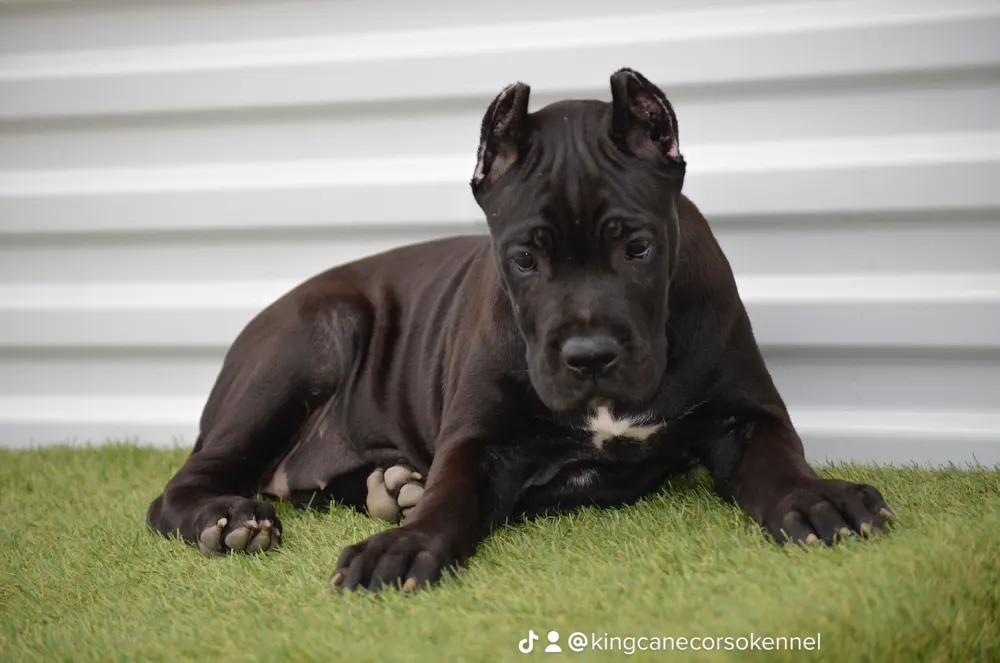
Cropped or natural is one of the first decisions a new Cane Corso owner hears opinions about, and most of those opinions come with heat. This page sticks to what the breed standards, veterinary organizations, research and California’s legislative record actually say, so you can make the call with your veterinarian.
Short answer: Both looks are accepted in American breed shows, and the AKC standard allows either. The current FCI (international) standard calls for uncropped ears. Major veterinary groups, including the AVMA and the California Veterinary Medical Association, oppose cropping done only for appearance. As of November 2026, a search of California’s codes found no statute that bans ear cropping; bans were proposed in 2004 and 2005 but are not in the codes today.
- Natural ears may suit you if you want to avoid elective surgery and aftercare, plan to show in FCI countries, or care about how strangers read your dog.
- Cropped ears may suit you if you want the traditional American show look the parent club prefers, and you have a licensed veterinarian willing to do it and talk you through risks and aftercare.
What is the difference between cropped and natural Cane Corso ears?
Natural ears are the ears the dog is born with: triangular, hanging, medium-sized flaps. Cropped ears have been surgically trimmed so that what remains is a short, upright triangle.
The AKC standard describes both. If uncropped, the ears are “medium size, triangular in shape, held tight to the cheeks, and not extending beyond the jaw bone.” If cropped, “it is in an equilateral triangle.” The FCI standard describes only one ear: “Triangular, drooping, of medium size,” and it ends the ear section with a plain sentence: “Ears are un-cropped.”
| Cropped ears | Natural ears | |
|---|---|---|
| AKC standard | Allowed (“equilateral triangle”) | Allowed (“medium size, triangular”) |
| FCI standard (2023) | Not described | Required: “Ears are un-cropped” |
| CCAA judges’ manual (US parent club) | Preferred | Acceptable |
| AKC show disqualification? | No | No |
| AVMA position | Opposes cropping “solely for cosmetic purposes” | No objection |
| California VMA position | Opposes cropping “solely for cosmetic purposes” (policy dated January 2010) | No objection |
| Procedure | Elective surgery; CCAA endorses it only when done by a veterinarian | None |
| Evidence it prevents ear infections | Very little research, per a 2016 PLOS ONE paper | Not applicable |
| How strangers perceive the dog | Rated more aggressive and less playful in one US study | Baseline in that study |
| Cost | Set by your veterinarian; ask for a written quote including aftercare | No procedure cost |
| Reversible? | No | Nothing to reverse |
Sources: AKC Official Standard of the Cane Corso; FCI Standard No. 343; CCAA Judge’s Manual 2026; AKC conformation FAQ; AVMA policy as reported by dvm360; California VMA policy (cvma.net, January 2010); Mills, Robbins and von Keyserlingk, PLOS ONE 2016.
Do Cane Corso breed standards require cropped ears?
No standard requires cropping. The AKC standard says ears “may be cropped or uncropped,” and the AKC’s conformation FAQ is direct: “No AKC breed standard has a disqualification for any of these alterations,” and there is “nothing in any breed standard that compels an owner to have this procedure performed.”
The US parent club does state a preference. The Cane Corso Association of America’s 2026 judges’ manual says: “While uncropped ears are acceptable, cropped ears are preferred; for historical preservation of the breed function, appearance and hygiene. The CCAA endorses only ear cropping performed by a veterinarian under humane and sterile conditions.”
The FCI went the other way. Its current standard, published in 2023, says “Ears are un-cropped” and describes the tail simply as “Natural.” So a dog with natural ears matches the international standard exactly, and a dog with cropped ears matches the American parent club’s preference. Our European vs American Cane Corso comparison covers the other differences between the two standards.
Is ear cropping legal in California?
As of November 2026, a search of California’s codes turned up no state statute that bans or specifically regulates ear cropping of dogs. Bans have been proposed more than once, and none of them is in the codes today. Here is what the record shows:
- Animal cruelty law: Penal Code section 597, the state’s main animal cruelty statute, does not mention ear cropping or tail docking.
- Veterinary practice law: Business and Professions Code section 4826 treats anyone who “performs a surgical or dental operation upon an animal” as practicing veterinary medicine, and section 4825 makes it unlawful to practice without a license, subject to the exemptions listed in section 4827. Ear cropping is surgery, so those are the sections to read. The one cosmetic-procedure limit in that chapter, section 4826.8, covers cat declawing, not dogs’ ears.
- 2004: Senate Bill 1548, a veterinary medicine bill by Senator Liz Figueroa, was amended to make ear cropping a misdemeanor unless it was done to treat disease or injury. In August 2004 the AKC reported that she “agreed to remove the ear cropping ban” from the bill. The trade publication dvm360 reported at the time that the California Veterinary Medical Association’s board had voted to support the ban.
- 2005: Assemblymember Paul Koretz introduced AB 418, described by the AKC as “a state bill to ban ear cropping.” The AKC’s alert noted it would not have prohibited “showing, owning, selling, buying or adopting a dog with cropped ears.” No such ban appears in the codes today.
- 2010: The California Veterinary Medical Association adopted the policy: “The CVMA opposes ear cropping and tail docking of dogs when done solely for cosmetic purposes.”
- 2021: Assemblymember Alex Lee introduced House Resolution 61, which said the Assembly “is committed to sensible and humane therapeutic veterinary procedures for companion animals.” As the AKC pointed out, “resolutions are not the same as laws.”
Two practical points. First, cropping is surgery, and the CCAA itself endorses it only when performed by a veterinarian. Second, the code sections above were read on a public mirror of the California codes in November 2026, and city and county ordinances were not reviewed. Laws change, so confirm the current rules with your veterinarian or the California Veterinary Medical Board, and check your city’s municipal code, before you book anything. This page is general information, not legal advice.
For the broader legal picture on owning a Corso here, see are Cane Corsos legal in California?
What do veterinarians say about ear cropping?
The major veterinary associations oppose cropping done only for looks. The American Veterinary Medical Association’s policy, announced in November 2008 and reported by dvm360, reads: “The AVMA opposes ear cropping and tail docking of dogs when done solely for cosmetic purposes. The AVMA encourages the elimination of ear cropping and tail docking from breed standards.”
The California Veterinary Medical Association’s policy uses the same wording and also encourages removing these procedures from breed standards.
The AKC takes the opposite view. Its conformation FAQ says ear cropping, tail docking and dewclaw removal “as described in certain breed standards, are acceptable practices,” and adds that “appropriate veterinary care should be provided.”
That is the honest state of the debate: breed organizations and veterinary organizations disagree. Whether a particular veterinarian will perform cropping varies, so your own vet is the right person to ask.
Does cropping prevent ear infections in a Cane Corso?
There’s little evidence either way. A 2016 study in PLOS ONE on ear cropping and tail docking noted that for the reasons usually given, such as preventing ear infections or injury, “there is very little research assessing the validity of these assertions.”
The CCAA lists “hygiene” among its reasons for preferring cropped ears. No published data comparing ear infection rates in cropped and natural Cane Corsos turned up in the research for this page, so it makes no claim that one is healthier. If your dog has recurring ear problems, that’s a question for your vet, who can look for the underlying cause.
Do cropped ears make a Cane Corso look more aggressive?
To many people, yes. In the 2016 PLOS ONE study, 392 participants rated photos of dogs. Dogs with cropped ears and docked tails were rated “more aggressive” and more dominant, and less playful and less attractive than the same breeds in natural form. In a second experiment, owners of modified dogs were seen as “less warm” than owners of natural dogs.
The authors cautioned that “caution should be exercised when making any generalizations,” since they used a convenience sample of US residents and only four breeds, and the Cane Corso wasn’t one of them. Still, it’s worth thinking about. A Corso already looks imposing. If you’ll be walking your dog in busy San Diego neighborhoods, at the beach, or past a nervous landlord, first impressions matter.
Some owners want exactly that deterrent look. That’s a legitimate preference. Just know that perception and temperament are different things: the ears change how a dog looks, not who it is. Our guide on whether the Cane Corso is an aggressive breed covers what actually shapes temperament.
How much does Cane Corso ear cropping cost?
No figure is given here, because clinics set their own prices and no reliable source for a typical range turned up. If you are considering it, ask a licensed veterinarian for a written quote that includes anesthesia, the surgery itself, pain management, follow-up visits and any taping or aftercare supplies. Then ask what happens, and what it costs, if the ears don’t stand or heal as expected.
Natural ears cost nothing beyond normal ear cleaning and checkups. For the full picture of yearly costs, see what a Cane Corso costs to own.
How do you care for natural Cane Corso ears?
Natural ears need routine attention, like any dog’s. Ask your vet how often to check and clean them and which cleaner to use. Redness, odor, discharge or frequent head shaking are reasons to book a visit rather than treat at home.
A natural ear on a Corso should sit high and fairly tight to the head. The AKC describes it as “held tight to the cheeks.”
Can you show a Cane Corso with natural ears?
Yes. In AKC shows, natural ears are allowed by the standard and are not a disqualification. The AKC FAQ adds that judges evaluate “compliance of that dog to the breed standard.” The CCAA’s manual says cropped ears are preferred, and in the same sentence says uncropped ears are acceptable.
In FCI countries, natural ears are what the standard describes. If you might ever show abroad, ask the national club about its rules for dogs with cropped ears or docked tails. Note that the FCI standard also lists “tailless, too short tail” as a disqualifying fault.
What about tail docking?
Tail docking is the companion question. The AKC standard says the tail “is docked at the fourth vertebrae,” while also describing natural tails, and the CCAA manual says docked tails are preferred but “natural tails are accepted.” The FCI standard describes the tail as “Natural.” The AVMA and California VMA policies quoted above cover docking as well as cropping. If tails matter to you, ask any breeder early how the litter’s tails are being handled.
Cropped or natural: which should you choose?
Here’s a fair way to think about it:
- Lean natural if you’d rather avoid an elective surgery and its aftercare, if you agree with the veterinary associations, if you might show under FCI rules, or if you want your Corso to read as approachable in public.
- Lean cropped if you want the look the US parent club prefers for the American show ring, you’ve found a licensed veterinarian who will do it and explain the risks, and you’re ready for the aftercare.
- Either way, make the decision before you pick up your puppy, talk to your vet first, and check current state and city rules.
Whatever you choose, ears don’t change temperament, health testing or structure. Those come from the parents.
What does King Corso Kennel focus on?
Aston’s program is built around health, structure and temperament rather than ear style, and the reason is personal. In 2014 he bought a male and a female from a backyard breeder for property protection. The male developed hip dysplasia; the female had cherry eye, joint problems and knee dysplasia. The surgeries cost more than the dogs. That’s why he studied genetics and pedigrees and built his program on European bloodlines.
Our breeding dogs with published scores, Giulio Caesar, Yunis, Queen, Roxy II and Kayla, are all hip and elbow scored HD-A / ED-0. Meet them on our dogs page and see how we screen on our health testing page.
If you have questions about ears for a specific litter, ask us and we’ll tell you how that litter is being handled. You can see current litters on our puppies page or call Aston at (619) 370-5227.
Comparing breeds? See all our Cane Corso comparisons side by side.
Frequently asked questions
Do Cane Corso ears stand up naturally?
No. The breed’s natural ear hangs. The FCI standard describes it as “triangular, drooping, of medium size,” and the AKC describes an uncropped ear as held tight to the cheeks. An upright, pointed Cane Corso ear is the result of cropping, not genetics. If you see a puppy advertised with ears that “stand on their own,” ask the seller what they mean.
Will cropping change my Cane Corso’s personality?
Neither breed standard links ear shape to temperament, and the research cited here measured how people perceive dogs, not how the dogs behave. What cropping changes is how other people read the dog: in a 2016 PLOS ONE study, dogs with cropped ears and docked tails were rated as more aggressive and less playful than natural dogs. Temperament comes from genetics, socialization and training.
Can I buy a puppy with natural ears and decide later?
Leaving the ears natural is the one choice that can’t be regretted surgically, because cropping can’t be undone. Whether a veterinarian will crop an older puppy, and at what age, is a question for that veterinarian, not something to assume. If you’re unsure, talk to your vet before you take the puppy home rather than after, and ask your breeder how the litter’s ears and tails are being handled.
Can a cropped Cane Corso be shown in Europe?
The FCI standard states “Ears are un-cropped,” so a cropped dog doesn’t match the international standard’s description. Showing rules for modified dogs are set by national kennel clubs and can involve local animal-welfare law, so ask the specific club before you enter. In AKC shows in the US, cropped and natural ears are both allowed.
Do natural-eared Cane Corsos get more ear infections?
No published data comparing ear infection rates in cropped and natural Cane Corsos turned up in the research for this page. The 2016 PLOS ONE paper said there is very little research on claims that cropping prevents infections. Routine checks and cleaning as your vet advises are the practical answer. Recurring infections usually have an underlying cause your vet should look into.
Does the AKC prefer cropped ears for the Cane Corso?
The AKC standard itself takes no side: ears “may be cropped or uncropped.” The breed’s AKC parent club, the Cane Corso Association of America, does state a preference in its 2026 judges’ manual: “While uncropped ears are acceptable, cropped ears are preferred.” Judges evaluate the whole dog against the standard, and neither ear style is a disqualification.
Is ear cropping banned anywhere?
Yes, in some places. The 2016 PLOS ONE paper notes that the European Convention for the Protection of Pet Animals bars these procedures for non-curative purposes, and that some Canadian provinces and US states restrict tail docking and, in some cases, ear cropping. In California, bans were proposed in 2004 and 2005, but a November 2026 search of the state codes found no ear cropping statute.