
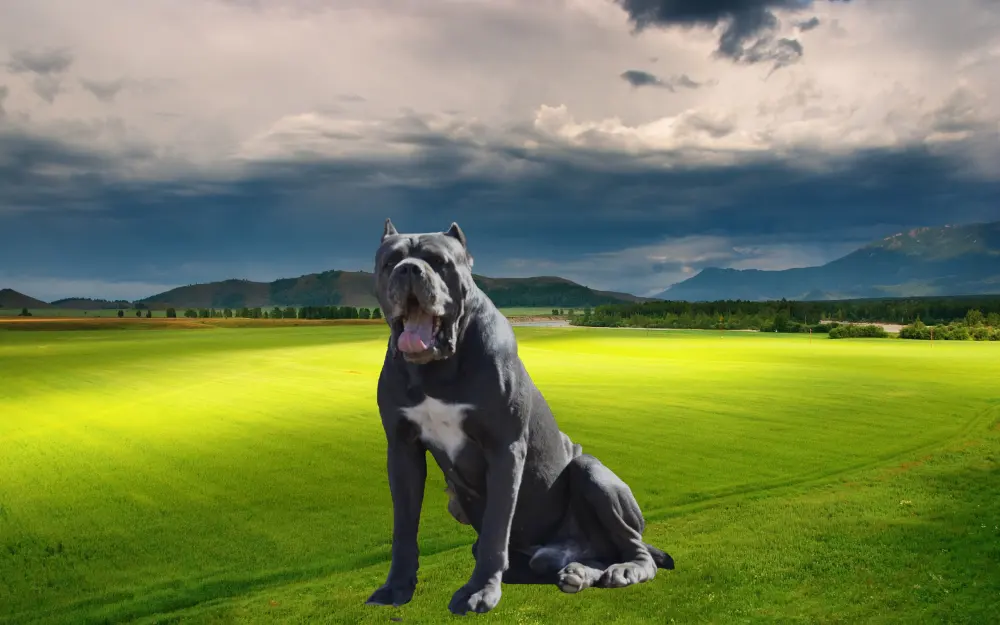
The Kangal and the Cane Corso are both called guardians, but they guard in completely different ways. The Kangal is a Turkish livestock guardian: it lives with a flock, makes its own decisions, and keeps predators away from sheep and goats. The Cane Corso is an Italian molosser that guards its family and property and works closely with its owner. Comparing them is less about which dog is tougher and more about which job you actually need done.
We breed Cane Corsos on an 80-acre ranch in Jamul, in San Diego County. We have tried to give the Kangal a fair hearing, because for some properties it is the better dog.
Short answer: The Kangal is taller, longer-lived on paper, and built to guard livestock independently; the Cane Corso is more trainable, more people-focused, and better suited to guarding a family home.
- Choose a Cane Corso if you want a personal and home guardian that lives inside with the family, responds well to training, and fits a suburban lot or a smaller rural property.
- Choose a Kangal if you have livestock or a large rural property, want a dog that patrols and decides for itself, and can provide tall, secure fencing and an owner who accepts limited obedience.
Cane Corso vs Kangal at a glance
Kangal figures come from the FCI’s Kangal Shepherd Dog standard and the AKC’s Anatolian Shepherd Dog page, since the AKC lists Kangal as another name for that breed. AKC trait scores run from 1 (low) to 5 (high).
| Cane Corso | Kangal (Anatolian Shepherd in the AKC) | |
|---|---|---|
| Origin | Italy | Turkey |
| Original job | Guarding property, family and livestock; cattle herding and big-game hunting | Guarding sheep and goats from predators |
| Height (FCI) | Males 64–68 cm (about 25–27 in); females 60–64 cm | Males 72–78 cm (about 28–31 in); females 65–73 cm, each ±2 cm |
| Height (AKC) | Males 25–27.5 in; females 23.5–26 in | Males 29 in; females 27 in |
| Weight | FCI: males 45–50 kg (about 99–110 lb), females 40–45 kg | FCI: males 48–60 kg (about 106–132 lb), females 40–50 kg. AKC: males 110–150 lb, females 80–120 lb |
| Life expectancy (AKC) | 9–12 years | 11–13 years |
| Coat | Short, dense, slight undercoat | 3–7 cm harsh outer coat with dense undercoat |
| Color (FCI) | Black, grey (blue), fawn, red, brindle | One color, fawn to wolf sable, with a black mask |
| Shedding / drooling (AKC) | 2 / 3 | 3 / 1 |
| Energy (AKC) | 4 | 3 |
| Trainability (AKC) | 4 | 2 |
| Openness to strangers (AKC) | 3 | 1 |
| Guarding style | Family and property guardian, works with its handler | Independent flock guardian; AKC says it should never receive protection training |
| AKC-recommended health tests | Hips, elbows, patella, cardiac, DSRA DNA, NCL1 DNA | Hips, elbows |
| AKC group | Working Group (since 2010) | Working Group (since 1996) |
Sources: AKC breed pages for the Cane Corso and Anatolian Shepherd Dog; FCI standards No. 343 (Cane Corso) and No. 331 (Kangal Shepherd Dog). Inch and pound conversions are ours.
Is a Kangal the same as an Anatolian Shepherd?
As far as the AKC is concerned, yes. The AKC registers these dogs as the Anatolian Shepherd Dog and states that “Anatolian Shepherds are also known as Goban Kopegi, Anatolian Karabash, or Kangal.” The FCI’s current standard, No. 331, is titled “Kangal Çoban Köpeği (Kangal Shepherd Dog)” and describes the Kangal as Turkey’s “highly praised National Dog.”
When a seller advertises a “Kangal” rather than an “Anatolian,” they usually mean a dog of the Turkish type the FCI describes: a single dun or fawn-to-wolf-sable color with a black mask. If you are shopping, ask which registry the parents are in and which standard the breeder follows, so you know what you are actually buying.
Is a Cane Corso bigger than a Kangal?
No. The Kangal is the taller dog, and usually the heavier one too. The FCI sets Kangal males at 72 to 78 cm at the shoulder (roughly 28 to 31 inches) and Cane Corso males at 64 to 68 cm (roughly 25 to 27 inches). That is a difference of three inches or more at the withers.
Weight is closer than the height gap suggests. FCI Kangal males weigh 48 to 60 kg (about 106 to 132 pounds) against 45 to 50 kg (about 99 to 110 pounds) for Corso males. The AKC’s Anatolian figures run higher, 110 to 150 pounds for males. Visually, the Kangal is a long-legged, rangy dog with a thicker coat, while the Corso is more compact and muscular with a broader, shorter muzzle.
If you are comparing because you want the biggest dog possible, remember that the biggest dog is not automatically the healthiest one. Our Cane Corso size and growth guide explains what a healthy Corso should look like at each stage.
How do Kangal and Cane Corso temperaments differ?
The Kangal is an independent decision-maker bred to work away from people; the Corso is a guardian bred to work with people. That single difference shapes everything else.
The FCI describes the Kangal as “steady and bold without aggression, naturally independent, very intelligent and tractable,” and “loyal and affectionate to owners, but wary of strangers when on duty.” The AKC adds that Anatolians “will protect their flock, livestock, children, smaller dogs, even the family cat, with intensity,” and that the breed is “extremely independent,” with an instinct “to take care of themselves and the flock without needing instruction.” It rates openness to strangers at 1 out of 5.
The Corso’s FCI standard calls it a “guardian of property, family and livestock; extremely agile and responsive.” The AKC describes Corsos as “intelligent, loyal, eager to please, versatile” but also “assertive and willful.” Corsos tend to stay close to their people and look to them for direction, which is why they suit life inside a family home.
One line from the AKC stands out for anyone thinking of a Kangal as a protection dog: “Under no circumstances should an Anatolian receive protection or guard-dog training.” The breed guards by instinct, and the AKC advises against adding bite work to an independent livestock guardian. Corsos, by contrast, compete in protection sport alongside obedience, agility, dock diving and tracking, according to the AKC. For more on the Corso side, read what the Cane Corso temperament is like.
Which is better for a family home?
For most suburban families, the Cane Corso. The AKC rates both breeds 3 out of 5 for being good with young children and 3 for being good with other dogs, so the ratings are even there. The difference is in daily life.
A Corso is happiest indoors with its people, takes direction, and adapts to a household routine. A Kangal was bred to spend its days with livestock, patrol large areas, and bark at and confront intruders on its own terms. In a small yard with neighbors on three sides, that instinct can turn into nuisance barking and fence-running. The AKC advises a “tall, strong fence and a locked gate” and says an Anatolian “must be kept on leash whenever he is taken out of the home.”
Kangals can be devoted to their families. The AKC notes the breed is “calm, friendly, and affectionate with his immediate family.” But a family that wants a dog to go to soccer games, walk calmly through town and greet guests politely will generally find that easier with a well-socialized Corso. Our article is the Cane Corso a good family dog? covers what that takes.
Which breed is easier to train?
The Cane Corso, clearly. The AKC rates Corso trainability at 4 out of 5 and Anatolian trainability at 2.
The AKC explains why: the Anatolian “was bred to work independently, make decisions on his own, and protect his flock from outsiders, and training the breed to respond to commands can be a challenge.” Obedience training is still “a must” and so is socialization, but owners should expect a dog that considers commands rather than snaps to them.
The Corso’s AKC training notes describe a dog that is “intelligent and eager to please” and “generally easy to train,” while warning that socialization and puppy classes are “a must” for a breed this big and strong, and that Corsos respond to rewards “far better than to harsh corrections.” If you want to do obedience, rally or other sports with your dog, the Corso is the much easier partner. Our guide to when to start Cane Corso training lays out the first year.
How much exercise and space does each need?
The Corso needs more structured exercise; the Kangal needs more space and security. The AKC rates Corso energy at 4 out of 5 and Anatolian energy at 3.
For Corsos, the AKC recommends a brisk walk or run “of at least a mile in the morning and again in the evening,” and says the breed needs mental stimulation as well as physical work. For Anatolians, it says the breed “only needs a moderate amount of exercise” and will be content with yard time and “a long walk once or twice a day,” provided the yard is well fenced.
In other words, a Corso can live well on a normal suburban lot if its owner commits to daily walks and training. A Kangal does best with acreage, livestock or a job to watch over, and strong containment.
Which breed is healthier?
Going by the AKC’s breed pages, the Anatolian has fewer common orthopedic problems than the Cane Corso, and its listed lifespan is longer. The AKC calls the Anatolian “overall a healthy and hardy breed” and says “hip dysplasia is not common in Anatolians, nor is bloat.”
Kangal and Anatolian
The AKC flags two specific points. The breed “can be sensitive to anesthesia,” so your vet should know before any procedure, and good breeders screen for entropion (inward-rolling eyelids). Its recommended tests are hip and elbow evaluations. Owners should still learn the signs of bloat, as with any large, deep-chested dog.
Cane Corso
The Corso’s record is more mixed. The AKC lists hip dysplasia, idiopathic epilepsy, demodex mange and eyelid abnormalities as screening concerns, plus bloat. Official screening in France from 1997 to 2017 found hip dysplasia in 51.9% of Cane Corsos assessed, though the rate fell significantly over time. A UK study found the breed had 14.66 times the odds of cherry eye compared with crossbreds. The AKC recommends hip, elbow, patella and cardiac evaluations and DNA tests for DSRA and NCL1.
Those numbers are exactly why parent screening matters so much in Corsos, and why hip and elbow scores come first in our program. Read our Cane Corso hip dysplasia guide for what to look for, and ask your vet to help interpret any results.
Bloat signs for both breeds
The Merck Veterinary Manual lists nonproductive retching, drooling and restlessness as signs of gastric dilation and volvulus and says “immediate medical and surgical intervention is required.” If you see them, go straight to an emergency vet.
What is the bite force of a Kangal vs a Cane Corso?
We could not find any peer-reviewed measurement of bite force for either breed. Both breeds get dramatic “PSI” figures attached to them online, but we found no published study behind any of those numbers. Treat them as unverified.
Here is what measured data actually looks like. A 2018 review in Frontiers in Veterinary Science summarized a study in which 22 awake dogs weighing 7 to 55 kg chewed on a transducer. Their bite forces ranged from 13 to 1,394 newtons, with a mean of 256 newtons. The highest reading is roughly 313 pounds of force. In another study of 20 anesthetized dogs of 5 to 40 kg, where jaw muscles were stimulated electrically, forces measured at the carnassial (back) teeth reached about 3,417 newtons, and “bite force significantly increased with body weight.”
The same review concluded that bite forces “were highly variable due to animal volition, situation, or specific measurement technique,” and that body weight and skull shape are the main factors. Two takeaways: a bigger, heavier dog generally bites harder, and anyone quoting a precise single number for a breed is guessing. Also, PSI is a unit of pressure, not force, so “PSI bite force” mixes up units.
Many searches ask who would win between these two. We do not compare dogs by fighting. Size, temperament, drive and how well a dog is bred and raised are what matter for an owner.
Can a Kangal or Cane Corso handle San Diego heat?
Both can, with management, but they cope differently. The Kangal comes from central Anatolia, which the AKC describes as a high plateau where “summers are dry and brutally hot, and the winters are snowy.” Its coat is 3 to 7 cm long with a dense undercoat, and the breed sheds that undercoat twice a year.
The Corso’s coat is much shorter, but it is a heavy, muscular dog that warms up quickly when it works. Inland San Diego County, including Jamul where we live, has hot, dry summer afternoons. For either breed, exercise early and late, provide shade and water, test pavement with your hand, and never leave the dog in a parked car. If your dog seems to be struggling in the heat, stop, get it into shade and call your vet. Our hot weather guide has more.
What does each breed cost?
We did not find an authoritative source for typical Kangal or Anatolian puppy prices in the US, so we will not quote one. For Cane Corsos, puppies from reputable breeders typically run $2,500 to $5,000 or more; see our Cane Corso price guide for what drives the range.
For running costs, both breeds need large-breed food, preventive care, training and licensing. With a Kangal, budget for serious fencing, which can be the biggest single expense on an open property. With a Corso, budget for training classes and a cushion for orthopedic care.
Should you get a Cane Corso or a Kangal?
Choose based on what you need guarded and how you live.
- The Kangal is the better choice for ranches and farms with sheep, goats or other stock, for large properties where a dog can patrol, and for owners who want a low-drool, hardy dog with a longer expected lifespan and are comfortable with an independent animal that will not be an obedience star.
- The Corso is the better choice for family homes, suburban lots and owners who want a guardian that lives indoors, trains readily, goes places with the family, and can take part in dog sports.
- Neither suits a first-time owner without professional training help, or a property without secure fencing.
Comparing more guardian breeds? See Cane Corso vs Boerboel, Cane Corso vs Dogo Argentino and our roundup of family guard dog breeds.
How does King Corso Kennel breed its Cane Corsos?
Our program exists because of a bad start. In 2014 Aston bought a male and a female Corso from a backyard breeder to protect the property. The male developed hip dysplasia and had trouble getting up; the female had cherry eye, joint problems and knee dysplasia. The surgeries cost more than the dogs, and both dogs needed long-term pain management.
So Aston studied genetics and pedigrees and built a program on European bloodlines selected for health, structure and temperament. All of our hip- and elbow-scored breeding dogs are HD-A / ED-0. HD-A is the top FCI hip grade, which the OFA’s matrix places alongside its Excellent and Good ratings, and ED-0 means no elbow dysplasia was found. They include Giulio Caesar, from a grand champion lineage in Bosnia with original Italian genetics, whom Aston calls very lovable, very trainable and very obedient; Yunis and Queen, imported from Serbia; Roxy II, from an Argentinian bloodline; and Kayla, bred at our ranch. Meet them on Our Dogs, read about our screening on the health testing page, or compare grading systems in FCI vs OFA hip and elbow scores.
You can visit a litter from around four weeks old and meet the parents on our 80-acre ranch in Jamul. A $500 reservation holds a puppy, and interest-free financing is available. See available puppies or call (619) 370-5227.
Comparing breeds? See all our Cane Corso comparisons side by side.
Frequently asked questions
Is a Kangal a mastiff?
Not in the usual sense. The FCI places the Kangal in Group 2, Section 2.2, the mountain-type molossoid breeds, while the Cane Corso sits in Section 2.1, the mastiff type. The Kangal is a livestock guardian with a longer muzzle, longer legs and a thicker coat than a mastiff, and its FCI standard lists a muzzle that is too short as a disqualifying fault.
Does a Kangal drool or shed more than a Cane Corso?
It drools much less and sheds more. The AKC rates the Anatolian 1 out of 5 for drooling against 3 for the Corso, and 3 for shedding against 2. The Kangal’s dense undercoat comes out twice a year, and the AKC recommends brushing every few days during those periods. The Corso needs weekly brushing, daily in spring.
Can a Kangal live in a house?
Many Kangals and Anatolians live partly indoors with their families, and the AKC describes them as calm and affectionate with their immediate family. But the breed was developed to work outdoors with livestock, and many are happiest with outdoor space and a job. Indoors, expect a watchful dog that barks at outside noises and needs a secure yard.
Is a Kangal good with other pets?
Often yes with animals it is raised with, because flock guardians bond with what they protect. The AKC says Anatolians will guard livestock, children, smaller dogs and even the family cat. Strange animals entering its territory are another matter. Corsos can also live with pets raised alongside them, but need careful introductions as adults.
Which breed lives longer, a Kangal or a Cane Corso?
The AKC lists the Anatolian Shepherd at 11 to 13 years and the Cane Corso at 9 to 12 years. A 2017 study of 232 Cane Corsos from 25 countries found a median lifespan of 9.29 years. Ask to see the parents’ joint scores, and ask your vet about keeping your dog at a healthy weight.
Can I protection-train a Kangal like a Cane Corso?
The AKC says no: “Under no circumstances should an Anatolian receive protection or guard-dog training.” The breed guards by instinct and works independently, so the AKC advises against formal bite work. Cane Corsos do compete in protection sports, according to the AKC, but even then the work should be done with a qualified trainer and a dog with a stable temperament.
Is a Kangal or Cane Corso better for a small property?
The Cane Corso. A Kangal’s instinct to patrol and confront intruders works best with room to range and strong fencing, while a Corso can live well on a normal lot if it gets daily walks and training. The AKC recommends a tall, strong fence and a locked gate for Anatolians. Check local leash rules too; San Diego County requires a hand-held leash of six feet or less away from home.