
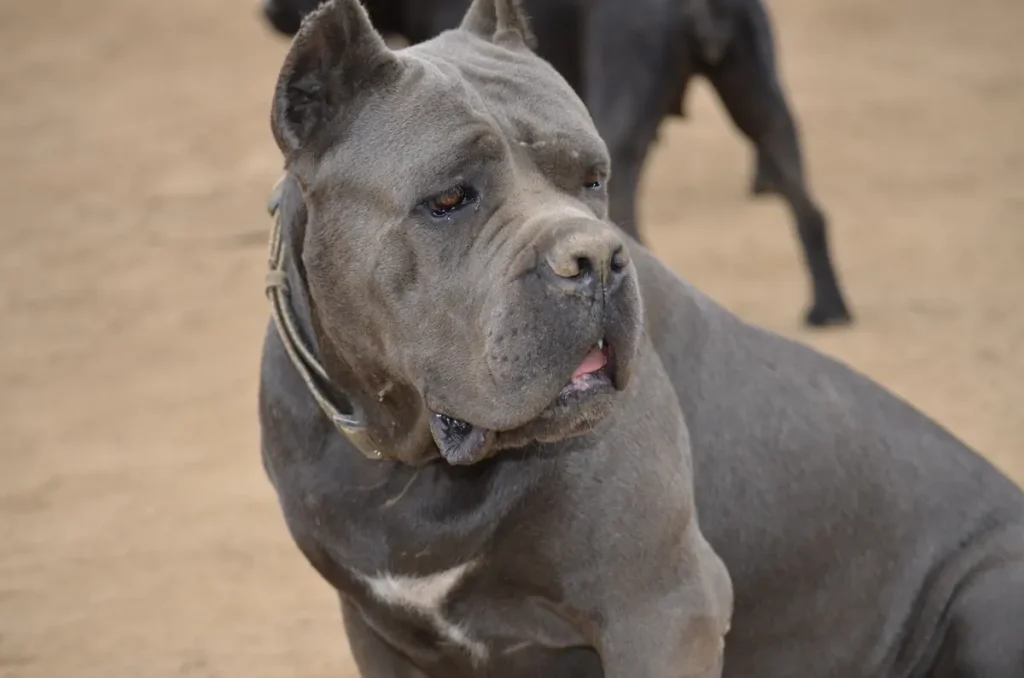
The Cane Corso and the Dogo Argentino get compared constantly because both are big, short-coated, muscular dogs with a reputation for courage. Up close they are built for different jobs. The Corso is an Italian guardian of property and family. The Dogo is an Argentine pack hunter bred to chase and catch wild boar and puma. That single difference explains most of what follows: energy, prey drive, how each one treats strangers, and what kind of home suits each breed.
We breed Cane Corsos on our ranch in Jamul, so we are not neutral. We have tried to write this the way we would explain it to a friend, including the cases where a Dogo is the better pick.
Short answer: The Cane Corso is the heavier, more territorial home guardian; the Dogo Argentino is the lighter, higher-energy athlete with a hunter’s drive. Neither is a beginner’s dog.
- Choose a Cane Corso if you want a watchful, home-focused guardian that is naturally reserved with strangers, sheds little, and needs solid daily exercise rather than an athlete’s workload.
- Choose a Dogo Argentino if you are an active, experienced owner who runs, hikes or does dog sports, wants a dog that is warmer with people, and can manage a strong prey drive around cats and small animals.
Cane Corso vs Dogo Argentino at a glance
The table below uses the AKC breed pages and the FCI breed standards, the two documents breeders and judges actually work from. AKC trait scores run from 1 (low) to 5 (high).
| Cane Corso | Dogo Argentino | |
|---|---|---|
| Origin | Italy (ancient Roman molosser line) | Córdoba, Argentina (standard set in 1928) |
| Original job | Guarding property, family and livestock; also cattle herding and big-game hunting | Pack hunting of big game such as wild boar and puma |
| Height (AKC) | Males 25–27.5 in; females 23.5–26 in | Males 24–26.5 in; females 24–25.5 in |
| Weight | AKC: proportionate to height. FCI: males 45–50 kg (about 99–110 lb), females 40–45 kg (about 88–99 lb) | AKC: 80–100 lb. FCI: about 40–45 kg males, 40–43 kg females |
| Life expectancy (AKC) | 9–12 years | 9–15 years |
| Coat and color | Short, dense, slight undercoat; black, grey (blue), fawn, red, brindle | Short, smooth; entirely white, one dark head patch allowed |
| Shedding / drooling (AKC) | 2 / 3 | 4 / 3 |
| Energy (AKC) | 4 | 5 |
| Trainability (AKC) | 4 | 5 |
| Openness to strangers (AKC) | 3 | 4 |
| Guarding style | Territorial guardian; standard calls it “guardian of property, family and livestock” | Hunter first; standard says it “should never be aggressive toward humans” |
| AKC-recommended health tests | Hips, elbows, patella, cardiac, DSRA DNA, NCL1 DNA | Hips, cardiac, BAER hearing test |
| Key breed health issue | Hip and elbow dysplasia, eyelid problems, cherry eye, bloat | Congenital deafness (about 1 in 4 in a US study), hips |
| AKC group | Working Group (since 2010) | Working Group (since 2020) |
Sources: AKC breed pages for the Cane Corso and Dogo Argentino; FCI standards No. 343 and No. 292; Strain, Vet Rec 2021 (deafness). Pound figures are our conversions from kilograms.
Is a Cane Corso bigger than a Dogo Argentino?
Yes, usually, though more in mass than in height. Male Corsos stand 25 to 27.5 inches at the shoulder under the AKC standard, while male Dogos stand 24 to 26.5 inches, so the tallest Corsos edge out the tallest Dogos by about an inch.
The weight gap is clearer. The FCI standard puts male Corsos at 45 to 50 kg (roughly 99 to 110 pounds) and male Dogos at about 40 to 45 kg (roughly 88 to 99 pounds). The AKC lists Dogos at 80 to 100 pounds and notes that Corsos are “often weighing more than 100 pounds.”
One caution: you will see Corsos advertised at 150 pounds or more. Those dogs are well outside the breed standard, and extra weight on a growing giant-breed frame is not a selling point. We explain why in our 200-pound Corso myth article and our size and growth guide.
How are the Dogo Argentino and Cane Corso temperaments different?
The Corso is a guardian that watches its territory; the Dogo is a hunter that wants to go. Both are confident and brave, but they direct that confidence differently.
The FCI standard describes the Cane Corso as a “guardian of property, family and livestock; extremely agile and responsive.” The AKC adds that Corsos are “intelligent, loyal, eager to please” but also “assertive and willful.” In daily life that means a dog that stays close to its people, watches the gate, and decides for itself whether a visitor is welcome. It tends to be reserved, not friendly, with strangers.
The Dogo’s standard reads very differently. It asks for a dog that is “silent, never barking on the trail,” with a keen nose, and it states plainly that the Dogo “should never be aggressive toward humans.” The AKC rates the Dogo a 4 out of 5 for openness to strangers against the Corso’s 3, and a 5 for energy against the Corso’s 4. Owners usually describe Dogos as affectionate, physical, busy dogs.
Where the Dogo is harder is prey drive. A breed developed to catch boar and puma will often fixate on cats, small dogs and wildlife. The AKC describes the Dogo as having “strong prey drive” and doing best “with an experienced owner.” Corsos can chase too, but their main instinct is to guard what is theirs.
For more on the Corso side, read what the Cane Corso temperament is really like.
Which is better with kids and family life?
Both can live well with children when they are raised with them and supervised, and neither should be left alone with young kids. The AKC gives both breeds a 3 out of 5 for “good with young children,” so the official ratings do not separate them.
The practical differences come from size and energy. A Corso’s guarding instinct can extend to the family’s children, which some parents like, but it means you have to manage visiting friends, rough play and loud games so the dog does not misread them. A Dogo is usually more openly social, but an 80 to 100 pound dog with a 5 out of 5 energy rating can flatten a toddler without meaning any harm.
In homes with cats, rabbits or small dogs, the Corso is usually the easier fit, because the Dogo’s hunting drive is the bigger management problem. Our guide on whether Cane Corsos are good with kids covers the house rules we give every family.
Which is easier to train, a Dogo or a Corso?
The AKC rates the Dogo slightly higher (5 out of 5 for trainability, against 4 for the Corso), but in practice both need an owner who is calm, consistent and starts early.
The AKC’s own training note for the Corso is blunt: socialization and puppy classes are “a must” for a breed this big and strong, obedience training “will keep them from becoming the boss,” and Corsos “respond to love and rewards far better than to harsh corrections.” The same applies to Dogos. Heavy-handed training makes a powerful dog defensive, not obedient.
Where the focus differs:
- Corso: socialize hard in the first months at home so the dog learns that ordinary people, delivery drivers and vet staff are normal. Teach “place,” calm greetings at the door, and a reliable release from guarding behavior.
- Dogo: build impulse control and a rock-solid recall early. Work on calm behavior around cats, squirrels and moving animals. Give the dog a job such as scent work, hiking or a sport so the drive has an outlet.
Our article on early socialization for Cane Corso puppies walks through the first weeks in detail.
How much exercise does each breed need?
The Dogo needs more. Its AKC energy score is 5, the maximum, and it was bred to hunt with a pack. Expect long daily walks plus running, hiking, swimming or sport work, and a securely fenced yard.
The Corso is no couch dog either. The AKC says Corsos “need serious exercise” and suggests a brisk walk or run “of at least a mile in the morning and again in the evening.” The difference is that a Corso is more content to patrol its yard and settle once it has had its outing, while an under-exercised Dogo tends to invent its own projects.
Both are large, fast-growing breeds, so go easy on a puppy’s joints. Ask your vet how much running and jumping is appropriate while your dog is still growing.
Which breed has more health problems?
They have different weak spots, and a good breeder screens for the right ones. Neither breed is “healthier” across the board.
Cane Corso: joints first
The AKC says responsible Corso breeders screen for “hip dysplasia, idiopathic epilepsy, demodex mange, and eyelid abnormalities,” and warns that large, deep-chested breeds are susceptible to bloat. The numbers on hips are sobering. A French study of official screening radiographs from 1997 to 2017 found hip dysplasia in 51.9% of Cane Corsos assessed, the highest of the 10 breeds studied, though the rate fell significantly over time. A UK study of primary-care records found Cane Corsos had 14.66 times the odds of cherry eye (prolapsed third-eyelid gland) compared with crossbred dogs.
That is exactly why hip and elbow scores on both parents matter so much in this breed. The AKC’s recommended Corso tests are hip, elbow, patella and cardiac evaluations plus DNA tests for DSRA and NCL1, two inherited conditions.
Dogo Argentino: hearing first
The Dogo’s big issue is congenital deafness linked to its white coat. In a 2021 study of 811 US Dogos tested with BAER (the standard hearing test), 20.35% were deaf in one ear and 5.43% in both, an overall prevalence of 25.77%. Dogs with a dark head patch had a lower rate. The FCI standard lists deafness as a disqualifying fault, and the AKC recommends BAER testing, hip evaluation and a cardiac exam.
Researchers have also identified genetic causes of narcolepsy and of a form of disproportionate dwarfism in some Dogo families. Neither has been shown to be common, but they are worth asking a breeder about.
Tests to ask for
- Cane Corso parents: hip and elbow scores (OFA or FCI), patella and cardiac exams, DSRA and NCL1 DNA results, plus an eye check.
- Dogo Argentino parents: BAER results for both ears on both parents (and ideally on the puppy), hip scores, cardiac exam.
For the full picture on Corsos, see our Cane Corso hip dysplasia guide. Ask your own vet how these results apply to a specific puppy.
What is the bite force of a Cane Corso vs a Dogo Argentino?
Nobody has published a reliable, peer-reviewed bite-force measurement for either breed that we could find. The numbers you see online, often quoted as several hundred “PSI,” do not trace back to a real study.
Here is what the science actually says. A 2018 review in Frontiers in Veterinary Science concluded that “the main factors affecting the bite forces in dogs and cats are body weight and the skull’s morphology and size,” and that measured bite forces “were highly variable due to animal volition, situation, or specific measurement technique.” One study it summarizes had 22 dogs of 7 to 55 kg chew on a transducer and recorded forces from 13 to 1,394 newtons (up to roughly 313 pounds of force), with a mean of 256 newtons.
Two more points worth knowing. First, PSI is a unit of pressure, not force, so “700 PSI bite” claims mix up units. Second, a dog’s willingness to bite during a test changes the reading enormously. The honest answer is that both breeds are large, broad-skulled dogs with strong jaws, and that is exactly why training and socialization matter. You can read the 2018 bite-force review yourself.
We also get asked which breed would win a fight. We don’t compare dogs that way. What matters for your family is size, temperament, drive and how well the dog was bred and raised.
How do they handle San Diego heat?
Both are short-coated, which helps, but both are big, heavily muscled dogs that build heat fast when they work. Inland San Diego County, including Jamul where we raise our dogs, gets hot, dry summer afternoons.
The Corso has a dark coat in most colors and a slight undercoat; the Dogo’s coat is entirely white. Whichever you choose, plan summer exercise for early morning and evening, check pavement with your hand before a walk, give shade and water outdoors, and never leave either breed in a parked car. If your dog seems to be struggling in the heat, stop, get it into shade and call your vet. Our hot weather guide goes into more detail.
What does each breed cost to own?
Puppy prices for both breeds vary widely with breeder, bloodlines and health testing, and we have not found an authoritative source that publishes a reliable average for the Dogo. For Corsos, puppies from reputable breeders typically run $2,500 to $5,000 or more; our Cane Corso price guide explains what drives that range.
Is it legal to own a Dogo Argentino or Cane Corso in California?
Yes. California law (Health and Safety Code 122331) lets cities and counties pass breed-specific rules only for spay/neuter and breeding requirements, and says no breed may be declared potentially dangerous or vicious under those ordinances. See where the Cane Corso is banned for the wider picture.
Should you choose a Cane Corso or a Dogo Argentino?
Choose based on your daily life, not on which dog looks tougher.
- The Dogo is the better choice for an experienced, very active owner who wants a training and adventure partner, enjoys a more outgoing dog with people, and has no cats or small pets. It is also a better fit if you prefer a lighter dog to handle on leash.
- The Corso is the better choice if your priority is a home guardian that stays close, watches the property and is naturally discerning with strangers, and you want a dog that settles once its exercise is done. It sheds less by AKC rating and usually lives more easily with cats raised alongside it.
- Neither is right if you are a first-time owner without access to a good trainer, or if no adult in the home can physically control a 90 to 110 pound dog on leash.
How does King Corso Kennel breed its Cane Corsos?
We start with health because of how we started. In 2014 Aston bought a male and a female Corso from a backyard breeder to protect the property. The male developed hip dysplasia and struggled to get up. The female had cherry eye, joint problems and knee dysplasia. The surgeries cost more than the dogs, and both dogs needed long-term pain management.
That experience is why our program is built on European bloodlines selected for health, structure and temperament. Every one of our hip- and elbow-scored breeding dogs is HD-A / ED-0: A is the top hip grade on the FCI scale (the OFA lines it up with its Excellent and Good ratings), and 0 means no elbow dysplasia was found. They include Giulio Caesar, a male from a grand champion lineage in Bosnia with original Italian genetics, whom Aston describes as very lovable, very trainable and very obedient; Yunis and Queen, imported from Serbia; Roxy II, from an Argentinian bloodline; and Kayla, bred here at the ranch. You can meet them on Our Dogs and see how we screen on our health testing page. If you want to understand what those grades mean next to OFA ratings, read FCI vs OFA hip and elbow scores.
Families can visit the litter from around four weeks old and meet the parents on our 80-acre ranch in Jamul. A $500 reservation holds a puppy, and interest-free financing is available. If a Corso sounds like your dog, see available puppies or call us at (619) 370-5227.
Still weighing other guardian breeds? Read Cane Corso vs Presa Canario and Cane Corso vs Boerboel.
Comparing breeds? See all our Cane Corso comparisons side by side.
Frequently asked questions
Is a Dogo Argentino a type of mastiff?
It is a molosser, the same broad family as mastiffs and the Cane Corso, and the FCI places both breeds in its Group 2 with the molossoid breeds. But the Dogo was built as a pack hunter, so it is leaner and more athletic than a classic mastiff. The AKC notes it is also known as the Argentinian Mastiff, a name that describes its family, not its build.
Can a Dogo Argentino and a Cane Corso live together?
They can, but two large, confident dogs in one home need careful management. Many trainers find opposite-sex pairs easier than same-sex pairs, and introductions should be slow, on neutral ground, with separate feeding areas. Many experienced owners raise one puppy to adulthood before adding the second. Ask a qualified trainer to help if either dog shows resource guarding or tension.
Do Dogo Argentinos shed more than Cane Corsos?
By AKC ratings, yes. The Dogo scores 4 out of 5 for shedding and the Corso scores 2. Both have short coats, but white Dogo hair shows on dark clothes and furniture. The Corso’s slight undercoat sheds more in spring, and the AKC recommends weekly brushing, daily during shedding season, to keep loose hair under control.
Should I buy a Dogo puppy that has not been BAER tested?
We would not. Roughly one in four US Dogos tested in a 2021 study was deaf in one or both ears, and deafness in one ear is easy to miss without a test. BAER is the standard hearing test, and the AKC recommends it for the breed. Ask to see the results for both parents and for the puppy you are considering, and have your vet explain them.
Which breed lives longer?
The AKC lists the Dogo Argentino at 9 to 15 years and the Cane Corso at 9 to 12 years, so the Dogo’s range is wider at the top end. A 2017 study of 232 Cane Corsos from 25 countries found a median lifespan of 9.29 years. Individual dogs vary, so treat these as ranges, not promises.
Are Dogo Argentinos good guard dogs?
They are protective, and the AKC rates the breed 5 out of 5 for watchdog and protective nature, the same as the Corso. The difference is focus. The Dogo’s standard emphasizes hunting and says it should never be aggressive toward humans, while the Corso’s standard names guarding property and family as its role. For a dedicated home guardian, most owners find the Corso more naturally territorial.
Is a Cane Corso or Dogo better for a first-time owner?
Honestly, neither is a typical first dog. If a first-time owner is set on one of them, the Corso’s lower energy can be easier to live with, provided the family commits to early socialization and a good trainer. The Dogo’s high drive and prey instinct demand more experience. Spending time with adult dogs of each breed before deciding helps a lot.