
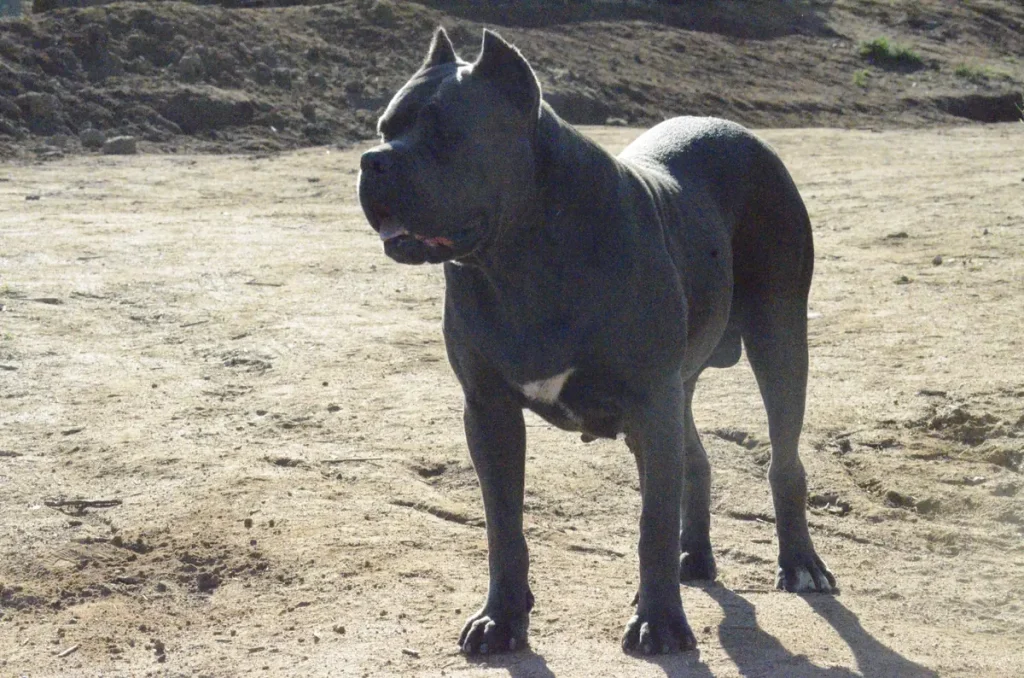
The Cane Corso and the Bullmastiff are closer in size than most people expect, and both were bred to guard. Stand them side by side and they look like cousins. Live with them and the differences show up fast: the Corso is a more athletic, more demanding working dog, while the Bullmastiff is a heavier, quieter guardian that was bred to stop an intruder without a lot of fuss.
We breed Cane Corsos on an 80-acre ranch in Jamul, in San Diego County. Below we compare the two breeds using the American Kennel Club and FCI standards, and we say plainly where the Bullmastiff is the better choice.
Short answer: the two breeds are about the same height, but the Bullmastiff is usually heavier and quieter, while the Cane Corso is leaner, more agile and longer-lived on average.
- Choose a Cane Corso if you want an athletic guardian that can walk, jog and train with you, you enjoy structured training, and a longer expected lifespan matters to you (AKC: 9–12 years).
- Choose a Bullmastiff if you want a quieter, heavier home guardian that is happy with brisk walks rather than runs, and you prefer a dog that the AKC calls “fearless at work, docile at home.”
| Cane Corso | Bullmastiff | |
|---|---|---|
| Height (AKC) | Males 25–27.5 in; females 23.5–26 in | Males 25–27 in; females 24–26 in |
| Weight | AKC: “proportionate to height.” FCI: males 45–50 kg (about 99–110 lb), females 40–45 kg (about 88–99 lb) | AKC: males 110–130 lb, females 100–120 lb |
| Life expectancy (AKC) | 9–12 years | 7–9 years |
| Coat | Short, double-layered; sheds year-round | Short; seasonal shedding |
| Shedding / drool (AKC 1–5) | Shedding 2, drooling 3 | Shedding 3, drooling 3 |
| Energy (AKC 1–5) | 4 | 4 |
| Barking (AKC 1–5) | 3 | 1 |
| Trainability (AKC 1–5) | 4 | 4 (but “can be quite strong willed”) |
| Guarding style | Agile property and family guardian; responsive | Bred to pursue and hold an intruder, then stay steady |
| AKC-recommended health tests | Hips, elbows, patella, cardiac, DSRA DNA, NCL1 DNA | Hips, elbows, cardiac, eye exam, thyroid |
| AKC group | Working | Working |
| Origin | Italy | England (Mastiff x Bulldog, 19th century) |
| Colors (FCI) | Black, greys (blue), fawns, red, brindles | Any shade of brindle, fawn or red |
| Puppy price | Reputable breeders: typically $2,500 to $5,000 or more | Ask breeders directly; we have no sourced figure |
Sources: AKC breed pages for the Cane Corso and Bullmastiff (height, weight, lifespan, 1–5 trait scores, recommended tests, history); FCI standards for the Cane Corso and the Bullmastiff (weight, colors, temperament). Pound figures for the Corso are our conversions from kilograms.
Is a Cane Corso bigger than a Bullmastiff?
Not really. They are about the same height, and the Bullmastiff is usually the heavier dog. The AKC lists male Bullmastiffs at 25 to 27 inches and male Cane Corsos at 25 to 27.5 inches. Females are 24 to 26 inches for the Bullmastiff and 23.5 to 26 inches for the Corso.
Weight is where they split. The AKC gives Bullmastiff males 110 to 130 pounds and females 100 to 120. The AKC sets no weight for the Corso beyond “proportionate to height,” but the FCI standard gives 45 to 50 kg for males (about 99 to 110 pounds) and 40 to 45 kg for females. The FCI Bullmastiff standard gives males 50 to 59 kg, so even under European standards the Bullmastiff carries more mass at the same height.
You see it in the build. The FCI asks for a Corso that is “robust and sturdy… nevertheless with some elegance,” with lean muscle. The Bullmastiff simply packs more weight onto a similar frame. If you are worried about how big a Corso really gets, our Cane Corso size and growth guide covers the growth curve.
What was the Bullmastiff bred for, compared with the Cane Corso?
The Bullmastiff was bred in 19th-century England to catch poachers; the Cane Corso was an Italian all-purpose farm and guard dog. The AKC says the Bullmastiff’s nickname is “The Gamekeeper’s Night Dog.” Gamekeepers crossed Mastiffs and Bulldogs, settling on roughly 60 percent Mastiff and 40 percent Bulldog, to get a dog fast and brave enough to run down a man at night but “tractable enough to hold but not maul a poacher.” The Kennel Club in England took the breed in 1924 and the AKC recognized it in 1933.
The Corso is older and more of a generalist. The AKC traces it to Roman molossers and says Corsi later worked at “wild boar hunting, farming, livestock droving, and most famously, guarding farmsteads.” The breed was almost extinct by the mid-20th century; Italian fanciers revived it from the 1970s, the first import reached America in 1988, and the AKC recognized it in 2010.
That history still shows. Bullmastiffs tend to be economical guardians: watchful, quiet, and steady once they have assessed a situation. Corsos are more versatile and more physically active.
Which is a better guard dog, Cane Corso or Bullmastiff?
Both are serious guardians, and the AKC gives each its top score of 5 out of 5 for watchdog and protective nature. The better choice depends on the kind of guarding you want and how much work you will put in.
The Bullmastiff is a quiet guardian. The AKC scores its barking 1 out of 5, the lowest possible, against 3 for the Corso. Many owners like that: the dog does not announce every passing car. The FCI describes it as “powerful; enduring, active and reliable. High-spirited, alert and faithful.”
The Corso is the more responsive, trainable working partner. The FCI calls it a “guardian of property, family and livestock; extremely agile and responsive,” and the AKC notes Corsos compete in protection sport, obedience, agility and tracking. If you want a dog you can train to a high standard and take on hikes, the Corso fits. If you want a calm presence at home, the Bullmastiff fits.
Some searches ask which breed would win a fight. We don’t compare dogs by fighting. What counts for a family is size, temperament, trainability and whether you can manage the dog’s drive.
Are Bullmastiffs or Cane Corsos better family dogs?
Both can be excellent family dogs when they are well bred and well raised, and the AKC scores both 3 out of 5 for being good with young children, meaning supervision is advised. The AKC rates both breeds 4 out of 5 for affection with family.
The practical differences are noise and exercise. The Bullmastiff is the quieter housemate, scoring 1 out of 5 for barking against the Corso’s 3. The Corso needs harder daily exercise, and because the AKC says many Corsos “can be dominant and protective,” it needs deliberate socialization to be relaxed around guests and children’s friends. Both breeds are strong enough to knock over a small child by accident, so teach kids how to behave around a big dog. Our guide on introducing a Corso to children has practical steps.
Is a Bullmastiff easier to train than a Cane Corso?
Not usually. The AKC scores both breeds 4 out of 5 for trainability, but it describes them differently. It says Cane Corsos “are intelligent and eager to please, so they are generally easy to train,” while it warns that the Bullmastiff “can be quite strong willed” and that rules and routines should be set early.
The bigger issue with a Corso is not willingness but consequence. The AKC says “many Cane Corsos can be dominant and protective” and that obedience training keeps them from becoming “the boss in the household.” With a dog this strong and protective, skipping training is a real risk.
Both breeds do best with consistent, reward-based training and early puppy classes. Read our post on early socialization for Cane Corso puppies for what the first weeks at home should look like.
How much exercise does a Cane Corso need compared with a Bullmastiff?
A Cane Corso needs more exercise. The AKC says “Cane Corsos need serious exercise”: a brisk walk or run of at least a mile in the morning and again in the evening, plus mental work, because the Corso “is happiest when given a job to do.”
For the Bullmastiff, the AKC encourages moderate daily exercise and says “Bullmastiffs are not the ideal breed for people who want a canine running partner, but they are great walking companions.” It also says “secure fencing is a must” for outdoor areas. A Corso can become a good jogging partner once it is fully grown, if your vet agrees.
With both breeds, protect puppies from too much running and jumping while they grow. The AKC Bullmastiff page also advises against exercise right before and after meals because of bloat risk.
Which lives longer, a Cane Corso or a Bullmastiff?
The Cane Corso does, on average. The AKC lists a life expectancy of 9 to 12 years for the Cane Corso and 7 to 9 years for the Bullmastiff. These are breed averages, and an individual dog’s genetics, weight and care can shift them either way.
Keeping either breed lean helps. The Orthopedic Foundation for Animals notes that the severity of hip dysplasia “can be affected by environmental factors, such as caloric intake or level of exercise,” and extra weight also raises heat risk in big dogs.
What health problems do Cane Corsos and Bullmastiffs have?
Both breeds share large-dog risks such as hip and elbow dysplasia and bloat, and each has its own list. For the Corso, the AKC says responsible breeders screen for “hip dysplasia, idiopathic epilepsy, demodex mange, and eyelid abnormalities,” and that deep-chested breeds are susceptible to bloat.
For the Bullmastiff, the AKC says breeders screen “for cardiac issues, hip and elbow dysplasia, hypothyroidism and eye problems,” and that Bullmastiffs “can develop cancer as well as bloat.”
Which health tests should a breeder show you?
- Cane Corso: hip evaluation, elbow evaluation, patella evaluation, cardiac exam, DSRA DNA test and NCL1 DNA test (AKC list).
- Bullmastiff: hip evaluation, elbow evaluation, cardiac exam, ophthalmologist evaluation and thyroid evaluation (AKC list).
Ask for the certificates on both parents. For bloat, learn the signs before your puppy comes home and talk to your vet about prevention; a large study of large and giant breeds found faster eating and a raised food bowl were among the factors linked to higher risk (Glickman et al., 2000). Our health testing guide explains what the paperwork should look like.
Can a Bullmastiff or Cane Corso live in hot weather?
Both can live in Southern California, but neither should be exercised in midday heat, and the heavier Bullmastiff carries more risk. In a UK study of more than 900,000 dogs under veterinary care, dogs over 50 kg had 3.42 times the odds of heat-related illness compared with dogs under 10 kg, and dogs heavier than average for their breed were also at higher risk (Hall et al., 2020). A male Bullmastiff in the AKC’s 110 to 130 pound range weighs about 50 to 59 kg, so most are at or over that line.
Inland San Diego County is noticeably hotter than the coast. NOAA’s 1991–2020 normals give an average August high of 88.6°F in El Cajon versus 77.3°F at San Diego’s Lindbergh Field. In Jamul and the other inland valleys, walk early or late, give shade and water, and keep the dog lean. More in our hot weather guide.
How much does a Cane Corso cost compared with a Bullmastiff?
Cane Corso puppies from reputable breeders typically run $2,500 to $5,000 or more. That is a market range, not our price; our Cane Corso price page explains what drives it. We could not find a reliable published price range for Bullmastiff puppies, so ask breeders and compare what health testing each price includes.
Running costs are similar, since the dogs are close in size. The heavier Bullmastiff may eat a little more, and anything dosed by weight costs more for a bigger dog. Budget for puppy classes, a large crate, and an emergency fund for problems such as bloat.
Should I get a Cane Corso or a Bullmastiff?
Get a Bullmastiff if you want a quieter, heavier home guardian, you prefer daily walks to runs, and you like the idea of a dog that rarely barks. The AKC sums the breed up as “fearless at work, docile at home,” and for many households that is exactly right.
Get a Cane Corso if you want an athletic guardian that can keep up with an active family, you enjoy training, and you value the longer average lifespan. Expect to invest more time in exercise and socialization, especially during the teenage months. A Corso suits owners who want an engaged working partner more than a lawn ornament.
Still deciding? Compare the Corso with the much larger English Mastiff and the wrinkly Dogue de Bordeaux.
What should you ask a Cane Corso breeder before you buy?
Ask for the parents’ hip and elbow results first, then ask to meet the parents and see how the litter is raised. Aston, who runs King Corso Kennel with his sons, learned why the hard way. In 2014 he bought two Corsos from a backyard breeder to guard his property. The male developed hip dysplasia and had trouble getting up; the female had cherry eye, joint problems and knee dysplasia. The surgeries cost more than the dogs did.
That is why he studied genetics and pedigrees and built our program on European bloodlines, with health, structure and temperament first. Our breeding dogs with published scores are hip and elbow scored HD-A / ED-0. On the FCI hip scale A is the top grade, which the OFA’s international matrix equates with its Excellent and Good ratings, and ED-0 is the “normal elbow joint” grade on the international (IEWG) elbow scale. Meet Giulio Caesar, Yunis, Queen Corso and the rest on our dogs page, and see our approach on the health testing page.
Families can visit a litter from around 4 weeks old and meet the parents. A $500 reservation holds a puppy, and interest-free financing is available. Check available puppies or call (619) 370-5227.
Comparing breeds? See all our Cane Corso comparisons side by side.
Frequently asked questions
Is a Bullmastiff the same as a Mastiff?
No. The AKC describes the Bullmastiff as the result of crossing Mastiffs with Bulldogs, at roughly 60 percent Mastiff and 40 percent Bulldog. The English Mastiff is a separate, much larger breed: the AKC lists Mastiff males at 160 to 230 pounds, against 110 to 130 pounds for Bullmastiff males. They share ancestry but have their own standards.
Do Bullmastiffs bark less than Cane Corsos?
Yes, by the AKC’s ratings. The AKC scores Bullmastiff barking 1 out of 5, its lowest level, and the Cane Corso 3 out of 5. That does not mean a Bullmastiff won’t alert you; the AKC still rates its protective nature 5 out of 5. It simply tends to watch quietly rather than bark at every noise.
Can a Bullmastiff or Cane Corso go jogging with me?
A grown Cane Corso usually can, with your vet’s approval; the AKC suggests walks or runs of at least a mile twice a day. The AKC says Bullmastiffs “are not the ideal breed for people who want a canine running partner, but they are great walking companions.” Neither breed should be run hard while still growing or in midday heat.
Which breed drools more, Bullmastiff or Cane Corso?
They are rated the same. The AKC gives both the Bullmastiff and the Cane Corso a 3 out of 5 for drooling, which it labels average. Expect some drool from either. If drool is a deal-breaker, both are better choices than the Neapolitan Mastiff or Dogue de Bordeaux, which the AKC rates 5 out of 5.
What colors do Bullmastiffs and Cane Corsos come in?
The FCI Bullmastiff standard allows “any shade of brindle, fawn or red,” with a black muzzle essential. The FCI Cane Corso standard allows black, several shades of grey (often called blue), fawn, stag red, dark wheat, and black or grey brindle. So black and blue are Corso colors, not Bullmastiff colors. See our Cane Corso colors guide.
Is a Cane Corso Bullmastiff mix a good family dog?
It can be, but you lose predictability. A cross can inherit the size, energy and health risks of either parent. Ask any seller of a mix for hip and elbow results on both parents, just as you would for a purebred. If you like both breeds, pick the one whose exercise needs and temperament fit your household, then buy from health-tested parents you can meet.
When did the AKC recognize the Bullmastiff and the Cane Corso?
The Bullmastiff has been in the AKC much longer. The AKC granted it full recognition in 1933, after the Kennel Club in England accepted the breed in 1924. The Cane Corso is a newcomer by comparison: the first import reached America in 1988 and the AKC recognized the breed in 2010. In the AKC’s 2025 popularity rankings the Corso is 11th and the Bullmastiff 78th.