
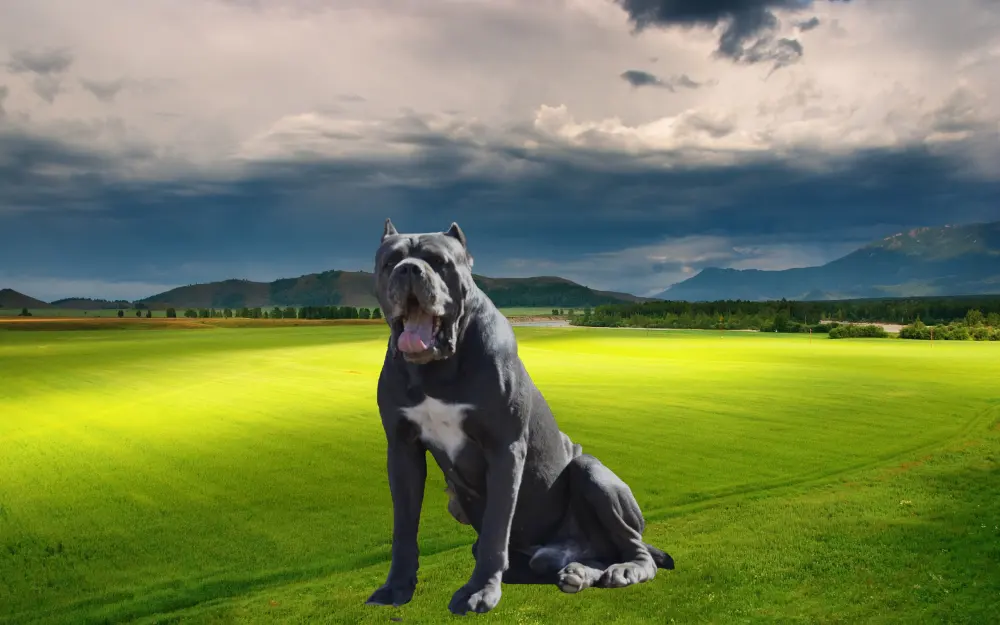
An adult Cane Corso needs serious daily exercise: the AKC’s guideline is a brisk walk, or better a run, of at least a mile in the morning and again in the evening, plus mental work. A Corso puppy needs far less, and the AKC warns that the wrong kind of exercise during growth is thought to harm developing joints. The trick is matching the work to the dog’s age.
We breed Cane Corsos in Jamul, and joint health is personal for us. Aston’s first Corso, bought from a backyard breeder, developed hip dysplasia and struggled to get up. That is why the hip and elbow scores of our breeding dogs matter so much to us. How you exercise a growing puppy is the part you control. This guide lays out what the evidence supports, age by age.
How much exercise does an adult Cane Corso need?
At least two brisk walks of a mile or more every day, plus training or other mental work. That is the AKC’s baseline for a healthy adult.
The AKC breed page says: “Cane Corsos need serious exercise. A brisk walk—or better yet, run—of at least a mile in the morning and again in the evening will sustain their health and muscle tone. They make great companions on long walks, hikes, or bicycle rides.” It rates the breed 4 out of 5 for energy.
Physical work is only half of it. The AKC adds that the Corso “was bred to work and is happiest when given a job to do. He needs mental as well as physical stimulation, or undesirable behavior will result.” With a guardian breed, that “undesirable behavior” can look like running the fence line, nuisance barking or chewing.
A realistic day for a fit adult looks like:
- a brisk morning walk of at least a mile, with sniff breaks;
- an evening walk of similar length;
- a short session of training, scent games or a food puzzle;
- free time in a secure yard, which is a bonus and not a substitute for walks.
How much exercise does a Cane Corso puppy need?
Much less than an adult, in short sessions. The AKC cites veterinary researchers who suggest walks of “about five minutes multiplied by every month of their age, once or twice a day.”
On that guideline, a 3-month-old puppy walks about 15 minutes at a time and a 6-month-old about 30 minutes. The AKC puppy exercise guide also says “The best surfaces are grass and packed sand to get started.”
The rest of a puppy’s activity should be self-directed play. The AKC’s large-breed guide explains: “It is often recommended that, in terms of running or jumping, puppies engage only in self-regulated play.” Puppy play, “where no one motion is extended for a period of time, and there is twisting and turning—especially when on softer surfaces such as grass or sand—is thought preferable.”
In plain terms, a Corso puppy that plays in the yard, stops, flops down and naps is doing it right. A puppy being jogged on a leash beside a bike is not.
How much should a Cane Corso exercise at each age?
Exercise should build gradually from short puppy walks to two long adult walks by about 18 months. Use this table as a starting point and adjust it with your vet. Minutes are per walk, based on the AKC’s five-minutes-per-month guideline.
| Age | Structured walks | Good activities | Avoid |
|---|---|---|---|
| 8–12 weeks | About 10–15 min, once or twice a day, as leash training allows | Free play on grass, short leash practice, gentle exposure to new places once your vet says it’s safe | Stairs, jumping in and out of cars, slick floors |
| 3–6 months | About 15–30 min, once or twice a day | Sniff walks, puppy class, short training games, play on soft ground | Forced running, long hikes, rough play with big adult dogs |
| 6–12 months | About 30–60 min, once or twice a day, building gradually | Longer walks on varied terrain, obedience, scent work, calm social outings | Jogging on pavement, repetitive jumping, agility jumps |
| 12–18 months | Adult-length walks if your vet agrees | Hiking, structured training, beginner sports without full jumps | Hard road running until your vet confirms growth is complete |
| 18 months–adult | Two walks of a mile or more, per AKC | Running, hiking, swimming, sports such as obedience, tracking, dock diving | Exercise in midday heat, hard work right after meals |
| Senior | Shorter, more frequent walks | Gentle walks, swimming, sniffing games | Sudden bursts after long rest; ask your vet about joint changes |
Sources: AKC puppy exercise guide (five minutes per month of age; jogging timelines); AKC large-breed care guide (growth plate timing, self-regulated play); AKC Cane Corso breed page (adult exercise, sports). Age bands and activity suggestions are our own practical summary.
When do Cane Corso growth plates close?
Later than in small dogs. The AKC says the growth plates of large and giant breeds fuse “as late as 16 to 18 months compared to 6 to 9 months in toy dogs.”
Growth plates are areas of soft, growing cartilage near the ends of the long bones. Until they close, the AKC’s large-breed guide warns that “Excessive, constant, percussive trauma, such as would occur in regimented running or jogging on hard surfaces” could affect them and “are thought to cause harm to the developing joints of large dogs.”
The same AKC large-breed guide adds: “While this is usually at 16 to 18 months for large dogs, ask your veterinarian with regard to your individual dog, particularly before engaging in sports requiring running and jumping.” A Corso is a big dog: the AKC standard puts males at 25 to 27.5 inches at the shoulder. Reading that guidance cautiously, we would hold off on serious running until at least 18 months, and ask your vet before you start. Our Cane Corso size and growth guide covers how fast Corsos grow.
Can Cane Corso puppies use stairs?
Keep a young Corso puppy off stairs where you can. A Norwegian study found that puppies of large breeds using stairs from birth to three months had a higher risk of hip dysplasia.
The study, published in the American Journal of Veterinary Research in 2012, followed 501 Newfoundlands, Labrador Retrievers, Leonbergers and Irish Wolfhounds from birth to their official hip X-rays. The authors concluded “that puppies ≤ 3 months old should not be allowed access to stairs, but should be allowed outdoor exercise on soft ground in moderately rough terrain to decrease the risk for developing radiographically detectable HD.” You can read the abstract on PubMed.
Two honest caveats. The Cane Corso was not one of the breeds studied, and the study looked at risk factors, not proof that stairs cause dysplasia. Still, a baby gate is cheap insurance. Carry the puppy on stairs through the early months, and ask your vet when to stop.
The same study found that off-leash exercise from birth to three months was linked to a lower risk. That lines up with the AKC advice above: free play on soft ground, not repetitive pounding.
When can I start running or jogging with my Cane Corso?
Not before your dog is physically mature, and for a Corso that means at least 12 to 18 months, and only with your vet’s go-ahead.
The AKC advises: “Hold off on jogging or running with your puppy on a leash until it’s mature. For smaller breeds, this is about 6 to 8 months; medium breeds 12 months; large breeds 12 to 18 months; and giant breeds 18 to 24 months old.” It explains that “The soft plates on bones need time to harden.”
The AKC guide does not say where a Corso sits between “large” and “giant,” so ask your vet about your own dog. When in doubt, wait.
When you do start:
- begin with short intervals of slow jogging inside a longer walk;
- favor dirt trails and grass over asphalt;
- add time slowly over several weeks;
- run in the cool morning hours, especially inland in summer.
Whether to X-ray hips and elbows before starting a running program is a good conversation to have with your vet, and our health testing page explains the scores we use for our own breeding dogs.
Can a Cane Corso go hiking?
Yes, an adult Corso can be an excellent hiking partner. The AKC calls the breed a great companion “on long walks, hikes, or bicycle rides.”
A few rules for San Diego County trails:
- Build up. Start with short hikes and add distance over weeks, especially with a young adult.
- Mind the heat. Inland trails get hot early. See our guide to Cane Corsos in hot weather.
- Check leash rules. San Diego County requires a hand-held leash no longer than six feet away from home, and City of San Diego parks, including trails and canyons, require a leash no longer than 8 feet.
- Watch for wildlife. County Animal Services publishes rattlesnake information and a brochure on its website. Read it before trail season.
- Carry water for the dog, not just for you.
Is it safe to exercise a Cane Corso after eating?
Wait at least an hour. The AKC says “The best time to take your puppy or adult dog for a walk is at least an hour after a meal.”
For a deep-chested breed like the Corso, there is another reason to be careful around meals. The AKC lists bloat as a risk for “Large and deep-chested breeds,” and the American College of Veterinary Surgeons describes gastric dilatation-volvulus (GDV) as “a rapidly progressive life-threatening condition of dogs that requires immediate medical attention.” ACVS says it is “commonly associated with rapid ingestion of large meals” and lists being “fed a single large meal once daily” among the factors associated with it. Ask your vet how to split your dog’s meals.
Learn the signs. ACVS says “Initial signs are often associated with abdominal pain,” and that as it progresses a dog “may begin to pant, have abdominal distension (bloated belly), or be weak and collapse.” If you see them, go to an emergency vet immediately. Ask your vet whether a preventive gastropexy makes sense for your dog; ACVS says it is “currently being recommended by many veterinary surgeons” for at-risk breeds.
What mental exercise does a Cane Corso need?
Daily training, problem-solving and a sense of having a job. The AKC says the Corso “is happiest when given a job to do.”
Good options at home:
- short obedience sessions (sit, down, stay, place, loose-leash walking);
- scent games, such as hiding treats around a room or yard;
- food puzzles and lick mats for part of each meal;
- “place” training, which teaches a guardian breed to settle on a bed when visitors arrive.
For owners who want more structure, the AKC notes that “Many Cane Corsos compete in agility, obedience, dock diving, protection sport, and tracking events.” For young dogs, the AKC advises modifying training for jumping sports such as agility until the growth plates have fused. Our article on when to start Cane Corso training covers the early basics.
Does exercise prevent hip dysplasia in Cane Corsos?
We have not found evidence that exercise alone prevents it, but OFA says exercise and calorie intake can affect how severe it gets.
The Orthopedic Foundation for Animals says “The severity of the disease can be affected by environmental factors, such as caloric intake or level of exercise.” For dogs living with the condition, OFA says “The key is weight control and exercise,” with the goal to “prevent the dog from becoming overweight to reduce mechanical stresses applied to the hip joints.” It notes swimming as a low-impact option.
That is why we start with screened parents and then think about exercise. The parents’ hip and elbow scores are something you can check before you buy; sensible exercise and a lean body are what you control afterward. Our hip dysplasia guide goes into more detail.
How can you tell if a Cane Corso is getting too much or too little exercise?
As a rough guide, a dog getting the right amount is calm at home, sleeps well and recovers quickly after walks. Too little shows up as restlessness and destructive behavior; too much shows up as soreness, lagging and reluctance to get up.
Signs of too little:
- pacing, whining or barking at every sound;
- chewing furniture, walls or door frames;
- rough, pushy play with people;
- weight gain.
Signs of too much, or the wrong kind:
- limping, stiffness after rest, or sitting down partway through walks;
- a puppy that won’t settle because it is overtired;
- trouble getting up after exercise.
Trouble getting up is the sign Aston saw in his first Corso. Any lameness or stiffness in a young Corso is worth a vet visit, not a wait-and-see.
How does a breeder’s choice of parents affect your Corso’s exercise life?
Sound joints are what let you give an adult Corso the exercise it needs. You can manage exercise carefully, but you can’t change the hips your puppy was born with.
At King Corso Kennel, the hip and elbow scores we publish for our breeding dogs are HD-A and ED-0, and you can see the dogs on our dogs page. We built the program on European bloodlines with an emphasis on health, structure and temperament because of what happened with those first two dogs in 2014. Families can visit a litter from around 4 weeks old and meet the parents, and we are happy to talk through an exercise plan for your home and schedule.
To see what is coming up, visit our puppies page or call (619) 370-5227.
Frequently asked questions
How long should I walk my Cane Corso each day?
For a healthy adult, plan on at least two brisk walks of a mile or more, morning and evening, which is the AKC’s guideline. Plan your day around those two walks, plus some training. Puppies need much less: about five minutes per month of age per walk, once or twice a day, according to the AKC.
Can a Cane Corso run with me on a bike?
An adult can, once your vet confirms growth is complete. The AKC lists bicycle rides among good activities for the breed, but advises waiting until a large breed is 12 to 18 months, or 18 to 24 for giant breeds, before leash running. Start slowly, use a proper bike attachment, stay off hot pavement and stop at the first sign of tiredness.
Is fetch good exercise for a Cane Corso puppy?
Short, gentle games on grass are fine. Long sessions of repeated sprinting, sharp stops and leaping for a ball are the kind of repetitive impact the AKC’s large-breed guidance warns about before growth plates close. Roll the ball rather than throwing it high, keep sessions brief, and let the puppy quit when it wants to.
Do Cane Corsos need a big yard?
A yard is useful but does not replace walks. A Corso alone in a yard tends to patrol rather than exercise, and the AKC’s guideline is two brisk walks of a mile or more daily. A secure fence matters more than yard size, both for safety and because San Diego County requires dogs at home to be controlled or contained.
At what age is a Cane Corso fully grown?
Corsos keep growing well past their first birthday. The AKC says large and giant breed growth plates fuse as late as 16 to 18 months, and notes large dogs are slower to mature mentally too, with the second year much better than the first. Ask your vet to confirm your dog’s growth is finished before starting hard exercise.
Is swimming good exercise for a Cane Corso?
It can be. OFA mentions swimming as a low-impact exercise for dogs with hip dysplasia, and the AKC lists dock diving among sports Corsos compete in. Introduce water slowly, supervise every session, and consider a dog life jacket. Not every Corso is a natural swimmer, and a heavy, muscular dog can tire quickly in the water.
Should a Cane Corso puppy be crate-rested to protect its joints?
No. Puppies need movement. The Norwegian study on large-breed puppies found off-leash exercise from birth to three months was linked to a lower hip dysplasia risk, while stairs were linked to a higher risk. Let your puppy play freely on soft, natural ground, limit stairs and forced exercise, and use the crate for naps and training.