
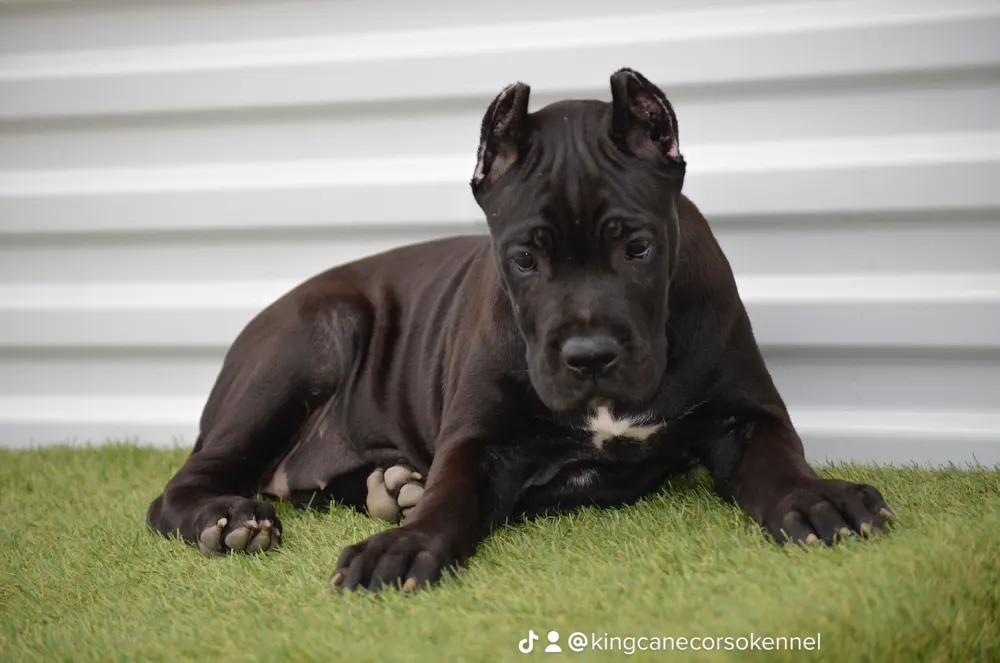
The Belgian Malinois and the Cane Corso both get called protection dogs, but they sit at opposite ends of the working-dog spectrum. The Malinois is a lean, intense herding breed that police and military units rely on. The Corso is a heavy Italian mastiff-type guardian that is happiest watching over its home. Families searching “Cane Corso or Malinois” are usually choosing between two very different lives with a dog. We breed Cane Corsos in Jamul, so we’ll be upfront: for the right handler the Malinois is a wonderful dog, and for many families it is the wrong one. Here is the comparison, sourced from the AKC, the FCI standard and the breed clubs.
Short answer: The Malinois is the lighter, longer-lived, higher-drive working dog that needs a job every day; the Cane Corso is the much heavier, calmer-at-home guardian that protects by presence. Most families looking for a house guardian will find the Corso easier to live with; most handlers looking for a sport or working partner will prefer the Malinois.
- Choose a Cane Corso if you want a large home and property guardian that settles indoors, you have space and a secure yard, and you can commit to early socialization and firm, fair rules.
- Choose a Belgian Malinois if you are an experienced, very active handler who wants to train several times a day, you’re interested in protection sport, tracking or agility, and you want a dog that can work for many years.
How do a Cane Corso and a Belgian Malinois compare side by side?
Here are the two breeds side by side from the American Kennel Club’s breed pages, with the FCI standard for the Corso’s weight.
| Cane Corso | Belgian Malinois | |
|---|---|---|
| Height (AKC) | Males 25–27.5 in, females 23.5–26 in | Males 24–26 in, females 22–24 in |
| Weight | AKC: “proportionate to height.” FCI: males 45–50 kg (about 99–110 lb), females 40–45 kg (about 88–99 lb) | Males 60–80 lb, females 40–60 lb |
| Life expectancy (AKC) | 9–12 years | 14–16 years |
| Coat | Short, stiff, dense, light undercoat | Short, straight, weather resistant, dense undercoat |
| Shedding (AKC, 1–5) | 2 | 3 |
| Drooling (AKC, 1–5) | 3 | 1 |
| Energy (AKC, 1–5) | 4 | 4 |
| Trainability (AKC, 1–5) | 4 | 5 |
| Mental stimulation needs (AKC, 1–5) | 3 | 4 |
| Good with young children (AKC, 1–5) | 3 | 3 |
| Protective nature (AKC, 1–5) | 5 | 4 |
| Guarding style | Guardian of property, family and livestock (FCI); deters by size | Handler-driven working dog; police and military work (AKC) |
| Health screening to ask for | Hips, elbows, patellas, cardiac, DSRA and NCL1 DNA (CCAA) | OFA hips, OFA elbows, eye exam by a boarded ophthalmologist (ABMC) |
| AKC group | Working (recognized 2010) | Herding (recognized 1959) |
| Origin | Italy | Belgium |
Sources: AKC breed pages for the Cane Corso and Belgian Malinois (size, lifespan, group, 1–5 trait ratings); FCI standard No. 343 (Corso weight and temperament); CCAA and ABMC health statements. Pound figures are our conversions from kilograms.
Is a Cane Corso bigger than a Belgian Malinois?
Yes, by a wide margin in weight. The AKC lists Malinois males at 60 to 80 pounds and females at 40 to 60, while the FCI standard puts Cane Corso males at 45 to 50 kg (about 99 to 110 pounds) and females at 40 to 45 kg. The AKC’s own description says Corsi often weigh more than 100 pounds.
In height they are closer. The AKC lists Malinois males at 24 to 26 inches and Corso males at 25 to 27.5. So a Corso is usually a little taller and much heavier: think of a big, broad mastiff next to a square, lean athlete. The AKC describes the Malinois as “strong and well-muscled, but more elegant than bulky.” See our Cane Corso size and growth guide for how Corsos reach adult size.
How do their temperaments differ?
The Malinois is an intense, driven working dog that wants to be doing something with its person almost all the time; the Corso is a more reserved guardian that is content to watch over the house between walks.
The AKC describes the Malinois as “a world-class worker who forges an unbreakable bond with his human partner,” and warns that “problems set in, though, when this people-oriented dog is underemployed and neglected.” It also notes that “like most herding breeds, Malinois have a high prey drive and are strongly interested in moving objects,” which “can lead to chasing children, vehicles, or other animals.”
The Corso’s description is different in tone. The AKC calls Corsi “intelligent, loyal, eager to please” but also “assertive and willful,” and says one “can end up owning an unwitting owner.” The AKC rates the Corso 4 out of 5 for affection with family against the Malinois’s 3, and 3 for mental stimulation needs against the Malinois’s 4, which fits a dog that watches over the house rather than constantly looking for work. Read more in what the Cane Corso temperament is like.
Which is better for protection, a Cane Corso or a Malinois?
It depends on the job. The AKC rates the Corso 5 out of 5 for protective nature and the Malinois 4, but the Malinois is the breed professionals choose for trained protection work.
The AKC says the Malinois is “intelligent and easily trained, which make it ideally suited to being a military and police dog.” Its speed, agility and drive to work for a handler make it the stronger choice for protection sport or a trained working dog in experienced hands.
The Corso is the natural home guardian. The FCI standard describes the breed as a “Guardian of property, family and livestock,” and the AKC notes that Corsi worked on Italian farms at boar hunting, droving and “most famously, guarding farmsteads and henhouses.” A Corso’s size and watchfulness deter most people before anything else happens. That was the job Aston wanted when he bought his first Corsos in 2014: protecting his property.
Two cautions. First, neither breed should be bought because it is “dangerous.” A good guardian is stable and socialized. Second, you may see bite-force numbers such as “700 PSI” for the Corso online; we have not found a published measurement behind them, so we don’t repeat them, and we don’t compare breeds by fighting. If you’re shopping for a family guardian, our family protection Cane Corso puppies guide explains what matters in a puppy.
Which is better with kids and family life?
The AKC rates both breeds 3 out of 5 for being good with young children, so neither is a carefree choice for a home with toddlers. The challenges are different.
With a Malinois, the main issue is drive. The AKC’s warning about chasing children and moving objects is real, and a Malinois that isn’t worked enough tends to invent its own jobs. With a Corso, the main issue is size and guarding: a heavy dog can knock a child over in play, and a Corso may take protecting “its” children too seriously when friends visit. The AKC rates the Corso 4 out of 5 for affection with family and the Malinois 3.
Both can live well with older, dog-savvy children and parents who supervise. If your house is busy and your time is limited, a Corso with a calm routine is usually easier than an under-exercised Malinois. See are Cane Corsos good with kids for how to set a Corso up with children.
Which is easier to train?
The Malinois learns faster and works harder; the AKC rates its trainability 5 out of 5, against 4 for the Corso. But “easier to train” isn’t the same as “easier to own.”
A Malinois will pick up a new skill quickly and then want to practice it, again and again. The AKC says “early socialization and obedience training are musts,” and its prey drive needs to be “directed into acceptable activities through training.” A Malinois in a novice’s hands can learn the wrong things just as fast as the right ones.
The AKC says Corsos “are intelligent and eager to please, so they are generally easy to train,” and “respond to love and rewards far better than to harsh corrections.” It also says socialization and puppy classes are “a must” for a breed this big and strong. The Corso’s challenge is the trait the AKC calls “assertive and willful,” and in a dog that often weighs more than 100 pounds that has to be addressed early. Read when to start Cane Corso training.
How much exercise does each breed need?
The Malinois needs far more structured activity than a Corso. The AKC is blunt: the Malinois “is not a dog who can be left in the backyard, and daily walks are not enough, either.”
The AKC adds that Malinois “make great running, hiking, and biking companions, and they excel at agility, tracking, herding, obedience, and Schutzhund (protection) competitions.” Plan on hard daily exercise plus training sessions, every day, for many years.
The Corso “needs serious exercise,” according to the AKC, which suggests “a brisk walk, or better yet, run, of at least a mile in the morning and again in the evening,” plus mental work, because the Corso “needs mental as well as physical stimulation.” Both breeds score 4 out of 5 for energy on the AKC’s ratings, but the Malinois’s higher rating for mental stimulation needs (4 against 3) and the AKC’s warning about an “underemployed” Malinois point to a dog that is harder to switch off at home. For puppies of either breed, avoid forced running while bones grow and ask your vet when to build distance.
Which handles San Diego’s weather better?
Both are short-coated and live comfortably in San Diego County, but weight is a known heat risk factor, and the Corso is much the heavier dog. A 2020 study of UK veterinary records found that dogs weighing over 50 kg (about 110 pounds), and dogs heavier than the average for their breed and sex, were at greater risk of heat-related illness (Hall and colleagues, Scientific Reports).
The AKC describes the Malinois coat as “comparatively short, straight, hard enough to be weather resistant, with dense undercoat,” shedding twice a year. The Corso’s undercoat, per the AKC, “varies in length depending on the climate the dog lives in.” On hot days, plan exercise for the cooler morning and evening hours and keep shade and water available. The AKC’s heatstroke guidance warns that dogs asked to run or play will do it “even when temperatures soar into the triple digits,” so with a high-drive Malinois you have to call the break. The AKC lists heavy panting, rapid breathing and excessive drooling among the early signs of overheating; if you see them, cool your dog down and call your vet.
What health problems should you screen for?
Both breeds should come from parents with hip and elbow results you can verify. Each parent club adds its own requirements.
Cane Corso
The AKC says responsible Corso breeders screen for “hip dysplasia, idiopathic epilepsy, demodex mange, and eyelid abnormalities,” and notes that large, deep-chested breeds are susceptible to bloat. The Cane Corso Association of America health statement lists as required tests for breeding dogs hips (OFA or PennHIP), elbows, patellar luxation, a cardiac exam, and DNA tests for DSRA and NCL1, with an eye exam and thyroid screening “optional but recommended.”
Belgian Malinois
The AKC calls the Malinois “generally a healthy breed” and says breeders screen for “hip and elbow dysplasia and certain eye problems.” The American Belgian Malinois Club’s health statement requires an OFA hip evaluation, an OFA elbow evaluation and an eye exam by a boarded ophthalmologist. It also suggests discussing epilepsy, cancer (hemangiosarcoma), thyroid and cardiac history, and temperament with any breeder.
The Malinois’s listed lifespan of 14 to 16 years is notably longer than the Corso’s 9 to 12. If lifespan is high on your list, that counts in the Malinois’s favor. Either way, ask your vet what to watch for at each stage of life, and see our Cane Corso hip dysplasia guide for the joint side.
What does each breed cost to keep?
A Cane Corso costs more to feed than a Malinois because it is much heavier (the top of the Corso male range sits about 30 pounds above the top of the Malinois male range), and weight-based costs like some medications scale with it. A Malinois’s costs show up more in training, gear and time.
For the purchase itself, Cane Corso puppies from reputable breeders typically run $2,500 to $5,000 or more; that is a market range, not our price. Our Cane Corso price guide explains what drives it. For either breed, paying for health-tested, temperament-tested parents is the cheapest decision you’ll make over the dog’s life.
Which should you choose?
Be honest about your time, experience and household. That answers it for most people.
- You want a working or sport partner and train daily: Belgian Malinois.
- You want a house and property guardian for a family: Cane Corso.
- You’re a first-time dog owner: the AKC says a Malinois “is not a dog who can be left in the backyard, and daily walks are not enough, either,” which is a lot to take on with a first dog. A Corso is demanding too, and the AKC calls early socialization and puppy classes “a must” for it.
- Lifespan matters most: Malinois (14–16 years vs 9–12, AKC).
- You hate drool: Malinois, rated 1 for drooling against the Corso’s 3.
- Still comparing guardian breeds? See Cane Corso vs German Shepherd and Cane Corso vs Doberman.
How does King Corso Kennel breed its Corsos?
We breed for health, structure and temperament because of what happened to Aston’s first two Corsos. In 2014 he bought a male and a female from a backyard breeder to guard his property. The male developed hip dysplasia and had trouble getting up; the female had cherry eye, joint problems and knee dysplasia. Their surgeries cost more than the dogs, followed by long-term pain management.
That’s why he studied genetics and pedigrees and built our program on European bloodlines. Our breeding dogs with published scores are all hip and elbow scored HD-A / ED-0: Giulio Caesar, from a grand champion lineage in Bosnia with original Italian genetics, whom Aston describes as very lovable, very trainable and very obedient; Yunis King Corso and Queen Corso, imported from Serbia; Roxy II King Corso, from an Argentinian bloodline; and Kayla King Corso, bred here. Pairings are Caesar x Queen, Caesar x Roxy II and Yunis x Kayla. Meet them on our dogs page.
On OFA’s international hip table, FCI A-1 matches OFA “Excellent” and A-2 matches “Good.” ED-0 is the normal grade on the international elbow scale. Our health testing page explains how we use these results; ask us which other results exist for a pairing you like.
We’re a family kennel, Aston and his sons, on 80 acres in Jamul, rated 5.0 on Google. Families can visit a litter from about 4 weeks old and meet the parents. To see who’s coming up, visit our puppies page or call (619) 370-5227.
Comparing breeds? See all our Cane Corso comparisons side by side.
Frequently asked questions
Is a Belgian Malinois the same as a German Shepherd?
No. They look similar and both are herding breeds, but the Malinois comes from Belgium and the German Shepherd from Germany. The AKC says the Malinois is one of four closely related Belgian herding breeds, first bred around the city of Malines. Malinois are lighter, with a shorter coat; the AKC lists their lifespan at 14 to 16 years.
Can a Cane Corso and a Malinois live in the same house?
They can, with work. The AKC rates both 3 out of 5 for getting along with other dogs. The Malinois’s prey drive (the AKC notes it is “strongly interested in moving objects”) and the weight gap between the two mean play should be supervised. Use separate crates and feeding spots, give each dog its own training time, and get a trainer’s help early if tension shows.
Why do police use Malinois instead of Cane Corsos?
Police and military work calls for a light, fast, agile dog that follows a handler’s cues closely. The AKC describes the Malinois as easily trained and ideally suited to military and police work. A Corso’s strengths, size and territorial guarding, suit protecting a home or property more than chasing and searching.
Do Malinois or Cane Corsos bark more?
The AKC rates both breeds 3 out of 5 for barking, so neither is a nonstop barker by nature. In practice, a bored or under-exercised dog of either breed barks more. Teach a “quiet” cue early and reward calm behavior when visitors arrive.
Is a Malinois or a Cane Corso better for a first-time owner?
For most first-time owners, a Corso from a breeder who selects for stable temperament is the more realistic choice. The AKC says a Malinois cannot be left in the backyard and that daily walks are not enough for it, which is a heavy commitment for a first dog. Whichever you choose, budget for puppy classes, a good trainer and plenty of socialization in the first months.
Do Cane Corsos or Malinois need a big yard?
A secure, well-fenced yard helps with both breeds, but it does not replace exercise. The AKC says a Malinois cannot simply be left in the backyard, and a Corso still needs daily walks and mental work. Size matters more for the Corso: a heavy dog needs room to move and a solid fence. Check fence height and gates before your puppy arrives.
Which breed lives longer?
The Belgian Malinois, on average. The AKC lists the Malinois at 14 to 16 years and the Cane Corso at 9 to 12. For a Corso, give yourself the best odds by choosing parents with documented hip and elbow scores, keeping your dog lean, and keeping up regular vet checks.