
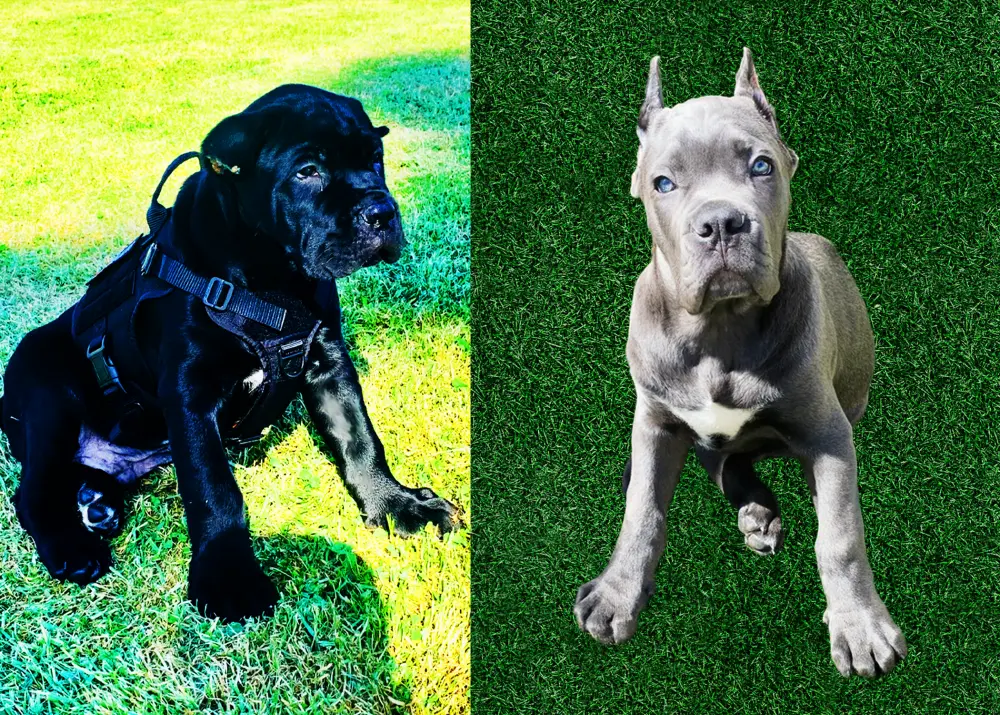
The German Shepherd is one of the most popular breeds in the U.S. (4th in the AKC’s 2025 popularity rankings) and a common first answer when people ask for a smart, protective family dog. The Cane Corso ranked 11th in 2025, so plenty of families weigh one against the other. They are very different animals: a herding breed built to move all day versus a mastiff-type guardian built to hold ground. We breed Cane Corsos in Jamul, so read this knowing that, and notice how often we tell you the Shepherd is the better fit. Every breed fact below comes from the AKC, the FCI breed standard or the breed’s parent club.
Short answer: The German Shepherd is the more adaptable, more trainable all-rounder with a longer listed lifespan; the Cane Corso is the bigger, heavier, more reserved home and property guardian that sheds less. For a first family dog that does a bit of everything, the Shepherd is usually the safer bet.
- Choose a Cane Corso if you want a large, calm-at-home guardian whose size deters people, you have space and a secure yard, and you prefer a short coat that sheds less.
- Choose a German Shepherd if you want a versatile working partner for training, sports or long days outdoors, you have young kids, and you can live with a lot of shedding.
How do a Cane Corso and a German Shepherd compare side by side?
Here is how the two breeds compare on the American Kennel Club’s breed pages, with the FCI standard filling in the Corso’s weight.
| Cane Corso | German Shepherd Dog | |
|---|---|---|
| Height (AKC) | Males 25–27.5 in, females 23.5–26 in | Males 24–26 in, females 22–24 in |
| Weight | AKC: “proportionate to height.” FCI: males 45–50 kg (about 99–110 lb), females 40–45 kg (about 88–99 lb) | Males 65–90 lb, females 50–70 lb |
| Life expectancy (AKC) | 9–12 years | 12–14 years |
| Coat | Short, stiff, dense, light undercoat | Double coat of medium length |
| Shedding (AKC, 1–5) | 2 | 4 |
| Drooling (AKC, 1–5) | 3 | 2 |
| Energy (AKC, 1–5) | 4 | 5 |
| Trainability (AKC, 1–5) | 4 | 5 |
| Mental stimulation needs (AKC, 1–5) | 3 | 5 |
| Good with young children (AKC, 1–5) | 3 | 5 |
| Protective nature (AKC, 1–5) | 5 | 5 |
| Guarding style | Guardian of property, family and livestock (FCI); deters by size | Mobile, handler-focused working dog; police and guard work |
| Health screening to ask for | Hips, elbows, patellas, cardiac, DSRA and NCL1 DNA (CCAA) | OFA hips and elbows plus club temperament test (GSDCA); degenerative myelopathy screening (AKC) |
| AKC group | Working (recognized 2010) | Herding (recognized 1908) |
| Origin | Italy | Germany |
Sources: AKC breed pages for the Cane Corso and German Shepherd Dog (size, lifespan, group, 1–5 trait ratings); FCI standard No. 343 (Corso weight and temperament); CCAA and GSDCA health statements. Pound figures are our conversions from kilograms.
Is a Cane Corso bigger than a German Shepherd?
Yes. A Cane Corso is both taller and considerably heavier than a German Shepherd. The AKC lists Corso males at 25 to 27.5 inches at the shoulder and German Shepherd males at 24 to 26 inches.
The weight gap is wider. German Shepherd males are listed at 65 to 90 pounds and females at 50 to 70. The AKC doesn’t give the Corso a weight range (“proportionate to height”), but the FCI standard puts males at 45 to 50 kg, roughly 99 to 110 pounds, and the AKC’s breed description says Corsi often weigh more than 100 pounds. The top of the Corso male range is about 20 pounds above the top of the Shepherd male range.
The shapes differ too. The Shepherd is longer than tall with smooth curves and a ground-covering trot. The Corso is broad and deep with a big, square muzzle and heavy bone. If you are planning space, a crate or a car around a Corso, our Cane Corso size and growth guide shows how fast they get there.
How do their temperaments compare?
Both breeds are loyal, protective and reserved with strangers, but the Shepherd is the more adaptable, people-oriented worker, while the Corso is the more independent, territorial guardian.
The AKC describes the German Shepherd’s defining traits as “loyalty, courage, confidence, the ability to learn commands for many tasks.” It quotes the breed standard on a “certain aloofness that does not lend itself to immediate and indiscriminate friendships.” That reserve is real, but Shepherds score 5 out of 5 for adaptability on the AKC’s ratings, so they generally cope well with new places, schedules and people once introduced.
The Corso scores 3 for adaptability. The AKC calls Corsi “intelligent, loyal, eager to please” and also “assertive and willful,” and warns that one “can end up owning an unwitting owner.” The AKC rates the Corso 4 out of 5 for affection with family and 3 for openness to strangers, and the FCI standard calls it a “Guardian of property, family and livestock.” On those ratings it is less of a “go anywhere, do anything” dog than a Shepherd. Our article on the Cane Corso temperament goes deeper on what that looks like day to day.
Which is better for protection?
Both breeds get the AKC’s top rating of 5 out of 5 for protective nature. The difference is how they protect, and that comes from their history.
The German Shepherd was developed in the late 1800s by Captain Max von Stephanitz, a German cavalry officer who, according to the AKC, “made it his mission to develop the ideal German herder.” The breed’s best-known qualities, the AKC says, “were forged not in the police academy but in the sheep pasture,” and it adds that Shepherds make “excellent police and guard dogs.” If you want a dog you can train for structured protection sport, the Shepherd’s 5 out of 5 trainability rating makes it the easier dog to shape.
The Corso’s background is the farm. The AKC notes Corsi worked at boar hunting, droving and “most famously, guarding farmsteads and henhouses,” and the FCI standard describes the breed as a “Guardian of property, family and livestock.” That is a dog bred to guard a place and the people in it, and a dog the AKC says often weighs more than 100 pounds is a deterrent on sight. That is exactly why Aston first bought Corsos in 2014: to protect his property.
Neither breed should be bought as a weapon. A protective dog is a stable, well-socialized dog that knows the difference between a guest and a threat. And if you have seen bite-force figures like “700 PSI” quoted for the Corso, we have not found a published measurement behind them, so treat them as marketing. We don’t compare dogs by fighting.
Which is better with children?
The German Shepherd is rated better with young children: the AKC gives it 5 out of 5, against 3 for the Cane Corso. For families with toddlers or small kids, that’s a meaningful difference.
A Corso can be a gentle, devoted family dog, and many are. The issue is mostly physics and management. A heavy, powerful dog in play can knock a small child over, and a Corso may take “protecting the kids” too literally when visiting children run and shriek. That is manageable with rules, supervision and training, but it requires adults who will do the work.
Shepherds bring their own challenges with kids, mainly a lot of energy and drive in adolescence. Still, on balance, a family with young children and limited dog experience will usually find a well-bred Shepherd easier. Read are Cane Corsos good with kids for how to set a Corso up with children.
Which breed is easier to train?
The German Shepherd is easier to train. The AKC rates its trainability 5 out of 5 and its need for mental stimulation also 5, while the Corso scores 4 and 3.
Shepherds thrive on learning. The AKC says “consistency and positive, reward-based training will yield excellent results.” The flip side is that a Shepherd without enough mental work gets frustrated.
The Corso learns well too. The AKC says Corsos “are intelligent and eager to please, so they are generally easy to train,” and “respond to love and rewards far better than to harsh corrections.” But it also says early socialization and puppy classes are “a must” for a breed this big and strong, because “many Cane Corsos can be dominant and protective.” The trait to plan for is the one the AKC calls “assertive and willful.” Start early; see when to start Cane Corso training.
How much exercise does each need?
The German Shepherd needs more exercise and more daily work. The AKC rates its energy 5 out of 5 and says “a dog who is not exercised enough will become frustrated and likely to develop undesirable behaviors.”
The Corso is rated 4 for energy. The AKC suggests “a brisk walk, or better yet, run, of at least a mile in the morning and again in the evening,” and adds that the Corso “needs mental as well as physical stimulation.” For the Shepherd, the AKC recommends “canine activities such as agility, herding, tracking, and dock diving” on top of daily exercise, which fits its 5 out of 5 rating for mental stimulation needs.
For puppies of either breed, keep exercise gentle and free-choice while bones are growing, and ask your vet when to build up to running. This matters most with a heavy, fast-growing breed like the Corso.
Which is better in San Diego’s climate?
The Cane Corso’s short coat is the easier one to live with in warm weather and in the house; the German Shepherd’s medium-length double coat sheds considerably more. Both can live comfortably in San Diego County with sensible summer care.
The AKC says the Shepherd has “a double coat of medium length” and sheds “more profusely once or twice a year.” It rates Shepherd shedding 4 out of 5, against 2 for the Corso. The Corso’s undercoat, per the AKC, “varies in length depending on the climate the dog lives in.” Don’t shave a Shepherd for summer without talking to your vet or groomer first.
The Corso’s weakness in heat is its weight. A 2020 study of UK veterinary records found that dogs weighing over 50 kg (about 110 pounds), and dogs heavier than the average for their breed and sex, were at greater risk of heat-related illness (Hall and colleagues, Scientific Reports). On hot days, plan exercise for the cooler morning and evening hours, keep shade and water available, and keep a Corso lean. The AKC lists heavy panting, rapid breathing and excessive drooling among the early signs of overheating; if you see them, cool your dog down and call your vet.
What health problems should you screen for?
Both breeds should come from parents with documented hip and elbow results. Beyond that, each breed’s parent club asks for different tests.
Cane Corso
The AKC says responsible Corso breeders screen for “hip dysplasia, idiopathic epilepsy, demodex mange, and eyelid abnormalities,” and that large, deep-chested breeds are susceptible to bloat. The Cane Corso Association of America health statement lists required tests for breeding dogs: hips (OFA or PennHIP), elbows, patellar luxation, a cardiac exam, and DNA tests for DSRA and NCL1, with an ophthalmologist’s eye exam and thyroid screening “optional but recommended.”
German Shepherd Dog
The AKC says Shepherd breeders should screen for “degenerative myelopathy and elbow and hip dysplasia,” and that the breed can experience bloat. The German Shepherd Dog Club of America’s health statement requires “OFA hips and elbows and the passing of our Temperament Test.” Notably, the Shepherd club makes a temperament test part of its health requirements.
For both breeds, learn the signs of bloat before you bring a puppy home and ask your vet about prevention. Our Cane Corso hip dysplasia guide covers the joint side in more detail.
What does each cost to own?
A Cane Corso will generally cost more to feed than a German Shepherd because it is the heavier dog, and anything dosed by weight costs more too. Training, insurance, vet care and the puppy itself are the bigger line items for both breeds.
For reference, Cane Corso puppies from reputable breeders typically run $2,500 to $5,000 or more, a market range rather than our price. Our Cane Corso price guide breaks down what drives it. Whichever breed you choose, paying for health-tested parents is cheaper than paying for joint surgery later.
Which should you choose?
Pick the dog that matches how you live, not the one with the toughest reputation.
- Choose the German Shepherd if you want a highly trainable, adaptable dog for an active family, you plan to do training or dog sports, you have young children, and you don’t mind vacuuming often.
- Choose the Cane Corso if you want a large, calm house dog that takes guarding the home seriously, you have room and a secure yard, and you want less shedding.
- If lifespan is a priority: the AKC lists 12–14 years for the Shepherd and 9–12 for the Corso. That is a real difference in favor of the Shepherd.
- If you’re still deciding between guardian breeds: compare our Cane Corso vs Doberman and Cane Corso vs Rottweiler pages.
How does King Corso Kennel breed its Corsos?
We breed for sound joints, correct structure and stable temperament, because Aston learned what happens when a breeder skips those. In 2014 he bought a male and a female from a backyard breeder to protect his property. The male developed hip dysplasia and struggled to get up; the female had cherry eye, joint problems and knee dysplasia. The surgeries cost more than the dogs, and pain management went on for years.
That’s what pushed him to study genetics and pedigrees and build our program on European bloodlines. Our breeding dogs with published scores are all hip and elbow scored HD-A / ED-0: Giulio Caesar, from a grand champion lineage in Bosnia with original Italian genetics; Yunis King Corso and Queen Corso, imported from Serbia; Roxy II King Corso, from an Argentinian bloodline; and Kayla King Corso, bred here. Pairings are Caesar x Queen, Caesar x Roxy II and Yunis x Kayla. Meet them on our dogs page.
On OFA’s international hip comparison, the FCI’s A grades line up with OFA “Excellent” (A-1) and “Good” (A-2). ED-0 is the normal grade on the international elbow scale. Our health testing page explains our approach, and you can ask us which further results exist for any pairing.
We are a family kennel, Aston and his sons, on an 80-acre ranch in Jamul, rated 5.0 on Google. You can visit a litter from about 4 weeks old and meet the parents. If the Corso is your breed, contact us or call (619) 370-5227.
Comparing breeds? See all our Cane Corso comparisons side by side.
Frequently asked questions
Can a Cane Corso and a German Shepherd live together?
Often, yes. The AKC rates both breeds 3 out of 5 for getting along with other dogs, so success depends on individual temperament and careful introductions. Raise them with separate feeding areas and crates, give each one-on-one training time, and step in early if either starts guarding food, toys or people. A trainer can help you plan the first weeks.
Does a Cane Corso shed less than a German Shepherd?
Yes. The AKC rates Corso shedding 2 out of 5 and Shepherd shedding 4. The Shepherd’s medium-length double coat sheds heavily once or twice a year. The Corso’s short coat still sheds, especially in spring, and the AKC recommends weekly brushing, daily during shedding season.
Do German Shepherds live longer than Cane Corsos?
On average, yes. The AKC lists German Shepherds at 12 to 14 years and Cane Corsos at 9 to 12. That’s a real gap. Within either breed, a dog from health-tested parents that stays lean and gets regular vet care has the best chance of reaching the top of its range, so ask breeders about the parents’ and grandparents’ health.
Which breed is better for a first-time owner?
For most first-time owners, a well-bred German Shepherd is easier, thanks to its higher trainability and adaptability ratings. A Corso can work for a committed beginner who starts puppy classes early, sets consistent rules and keeps socializing through adolescence. Either way, line up a trainer before the puppy comes home and choose a breeder who stays in touch.
Are German Shepherds or Cane Corsos better apartment dogs?
Neither is ideal for a small apartment. The Shepherd needs a lot of daily exercise and mental work; the Corso is calmer indoors but very large and protective of its space, which can make shared hallways and elevators stressful. If you rent, check your lease and any breed or weight limits first, and plan on long daily outings with either dog.
What does “HD-A” mean when a breeder lists it?
HD-A is the best grade on the hip scale used by the FCI in Europe. OFA’s international comparison table lines FCI A-1 up with OFA Excellent and A-2 with OFA Good. Ask to see the certificate, check that the dog’s name and ID match, and remember it describes the parent, not a guarantee for each puppy.
When should a puppy of either breed start training?
On the first day home. Start with name recognition, house training, crate comfort and gentle handling, then add a puppy class once your vet says your pup’s vaccinations allow it. Early socialization with new people, sounds and surfaces matters for both breeds. Our guide on early socialization for Cane Corso puppies has a checklist.