
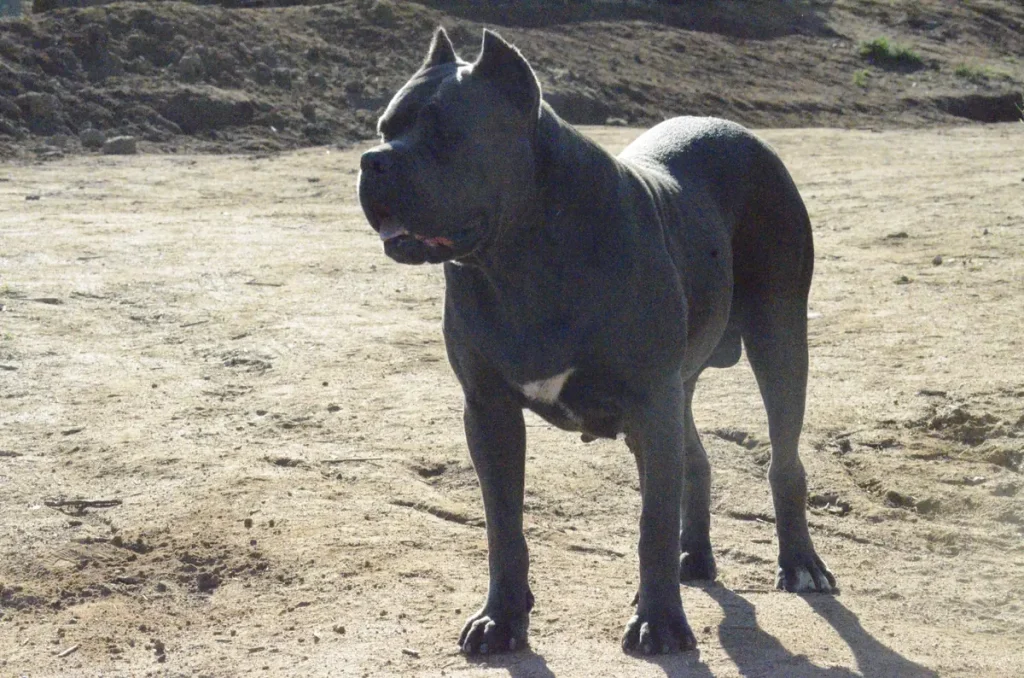
The health problems to know about in Cane Corsos are hip and elbow dysplasia, eyelid problems such as entropion, ectropion and cherry eye, bloat, idiopathic epilepsy and demodex mange, plus two inherited conditions that now have DNA tests: DSRA and NCL1. No reliable study says how common each one is in the breed. But this is a large, deep-chested breed, and a few of these conditions are expensive or dangerous when they do appear.
We write this as breeders who learned it the hard way. Aston’s first two Cane Corsos came from a backyard breeder in 2014. The male developed hip dysplasia; the female had cherry eye, joint problems and knee dysplasia. Their surgeries cost more than the dogs. Everything below is what we wish he had known then. It is general information, not veterinary advice: if your dog shows any of these signs, ask your vet.
What health problems are common in Cane Corsos?
The AKC lists hip dysplasia, idiopathic epilepsy, demodex mange and eyelid abnormalities as conditions responsible breeders screen for, and warns that large, deep-chested breeds are susceptible to bloat. The national breed club’s recommended tests, as listed by the AKC, are a patella evaluation, hip evaluation, elbow evaluation, cardiac exam, and DNA tests for DSRA and NCL1.
No reliable study gives the percentage of Cane Corsos affected by each condition, so we will not invent one. Here is a quick overview, then each condition in more detail.
| Condition | What it is | Signs owners notice | What to ask a breeder |
|---|---|---|---|
| Hip dysplasia | Malformed hip joint that develops during growth | Hind-leg weakness, pain, trouble rising | Hip scores for both parents (OFA or FCI) |
| Elbow dysplasia | Inherited elbow joint disease | Front-leg lameness, often subtle | Elbow scores for both parents |
| Cherry eye | Third eyelid gland pops out | Red, swollen mass in the inner corner of the eye | Any cherry eye in parents or relatives |
| Entropion | Eyelid rolls inward | Squinting, tearing, holding the eye shut | Eyelid problems in the line |
| Ectropion | Lower eyelid rolls outward | Sagging lower lid, mucus discharge | Eyelid problems in the line |
| Bloat (GDV) | Stomach dilates and can twist | Retching with nothing coming up, swelling belly, distress | Bloat in relatives |
| Idiopathic epilepsy | Seizures with no cause found | Seizures | Seizures in the line |
| DSRA | Inherited disorder of teeth, growth and retina | Discolored, brittle teeth; disproportionate growth; vision loss | DNA results for both parents |
| NCL1 | Inherited neurological storage disease | Progressive blindness and loss of coordination in a young dog | DNA results for both parents |
Sources: AKC Cane Corso breed page; OFA; VCA Animal Hospitals; American College of Veterinary Surgeons; Christen et al., Genes, 2021; Kolicheski et al., J Vet Intern Med, 2017.
Are Cane Corsos healthy dogs?
The AKC describes Cane Corsos as “generally healthy dogs” and lists a life expectancy of 9 to 12 years. That is a fair summary, with one caveat: the AKC says it in the same sentence as its list of conditions responsible breeders screen for. Hip, elbow and eyelid problems are inherited and can show up while a dog is still young, so without screened parents a buyer has no way to judge the risk.
Lifespan is covered in detail in how long Cane Corsos live. The short version is that the only published study found a median of 9.29 years, and that page covers what the evidence says about keeping a dog lean.
What is hip dysplasia in a Cane Corso?
Hip dysplasia is a malformation of the hip joint that develops as the puppy grows, leading to looseness and, over time, arthritis. VCA Animal Hospitals describes it as “a deformity of the hip that occurs during growth” and calls it a genetic disease that is also affected by diet, exercise and growth rate. It says weakness and pain in the hind legs are the usual signs.
Because it develops during growth, you cannot see it in a young puppy. It is diagnosed with X-rays; VCA says a hip X-ray under general anesthetic is the preferred method. OFA notes that severity can be affected by caloric intake and exercise, so a puppy’s diet and activity matter too.
What to watch for: VCA lists a wobbly gait, reluctance to rise from sitting or lying down, limping and reluctance to climb stairs. Aston’s first male showed it as trouble getting up. Mention anything like this to your vet early.
Treatment: VCA lists medication, weight control, moderate exercise and physical therapy, which it calls “highly effective at improving the quality of life” for affected dogs, and surgery such as total hip replacement or femoral head and neck ostectomy when that is not enough. Your vet will guide which fits your dog.
Screening: ask for hip scores on both parents. OFA grades hips Excellent, Good or Fair within normal limits; the FCI uses letters, with A described as no signs of hip dysplasia. Our hip dysplasia guide covers raising a puppy to protect its joints, and FCI vs OFA scores explains how to read the certificates.
Do Cane Corsos get elbow dysplasia?
Yes, and the national breed club recommends elbow evaluation alongside hips. OFA describes elbow dysplasia as “an inherited polygenic disease in the elbow,” meaning many genes are involved. It covers three underlying problems in the joint that can occur alone or together.
The signs are easy to miss. OFA says the lameness “may remain subtle for long periods of time.” If you notice a front-leg limp, mention it to your vet. OFA will not certify a normal elbow until a dog is two years old, so again, the parents’ results are what you have when you buy a puppy. On the 0 to 3 elbow scale, grade 0 means radiographically normal.
Do Cane Corsos get cherry eye?
They can. Aston’s first female did. Cherry eye is a prolapse of the gland of the third eyelid. VCA describes it as “a red, swollen mass on the lower eyelid near the nose or muzzle, resembling a cherry,” and lists the Neapolitan mastiff among the breeds most affected. The Cane Corso is not named on that list, and we have not found a published figure for how often it happens in the breed.
The treatment point matters, because it affects the dog for life. VCA says treatment “involves surgical replacement of the third eyelid gland,” and that removing the gland is not a recommended treatment, because without enough tear production a dog is much more likely to develop dry eye. VCA calls replacement “always the first treatment choice,” says it is essential to treat the condition as soon as possible, and adds that in severe or chronic cases there may be no option other than removal. If your Corso develops cherry eye, see your vet promptly and ask which approach they recommend and why.
People often search for cherry eye surgery cost. We have not found a reliable published figure, and prices vary by clinic and by whether one or both eyes are involved. Ask your vet for an estimate.
What eyelid problems do Cane Corsos have?
The two to know are entropion, where the eyelid rolls in, and ectropion, where it rolls out. Both fall under the “eyelid abnormalities” the AKC says responsible breeders screen for.
Entropion
VCA defines entropion as an abnormality “in which the eyelid rolls inward,” which often causes the hair on the eyelid to rub against the cornea. It is “considered a hereditary disorder,” is “usually diagnosed in puppies under one year of age,” and VCA lists the Bullmastiff and Neapolitan mastiff among affected breeds. Most dogs squint, hold the eye shut and tear excessively. The treatment is surgery, and VCA notes that most dogs wait until they reach adult size, at six to twelve months, before having it.
Ectropion
Ectropion is the opposite: the eyelid, usually the lower one, rolls outward. VCA includes the Mastiff among affected breeds. Signs are a sagging lower lid and a thick discharge along the lid. VCA says mild cases are generally managed with medical therapy, while in severe cases the eyelids can be shortened surgically.
Do Cane Corsos get bloat?
Yes. Bloat, or gastric dilatation-volvulus (GDV), is the emergency every Cane Corso owner should know. The AKC says large and deep-chested breeds are susceptible to it. The American College of Veterinary Surgeons calls it “a rapidly progressive life-threatening condition of dogs that requires immediate medical attention” and reports a mortality rate of approximately 15%.
Risk factors named by ACVS include a deep chest, being fed a single large meal once daily, being older, and being related to dogs that have had it.
Early signs listed by ACVS include an anxious look or looking at the abdomen, standing and stretching, drooling, a distending abdomen, and retching without producing anything. If you see these, go to your vet or an emergency clinic immediately. Do not wait to see if it settles.
Prevention: ACVS says many veterinary surgeons recommend preventive (prophylactic) gastropexy for at-risk breeds, a procedure that fixes the stomach to the abdominal wall, and that it can often be done at the same time as a spay or neuter. Ask your vet whether it makes sense for your Corso. Feeding more than one meal a day also avoids one of the listed risk factors; ask your vet about a feeding routine.
Which genetic diseases can DNA tests catch in Cane Corsos?
Two inherited diseases described in Cane Corsos have DNA tests the breed club recommends: dental-skeletal-retinal anomaly (DSRA) and neuronal ceroid lipofuscinosis (NCL1). Both are serious, and for both the parents can be tested before a litter is planned.
- DSRA: a 2021 study in Genes described Cane Corsos with “brittle, discolored, translucent teeth, disproportionate growth and progressive retinal degeneration resulting in vision loss,” and found the condition inherited in an autosomal recessive way. That means a puppy has to inherit the gene variant from both parents to be affected, and the authors say genetic testing can be used to detect unaffected carriers and avoid breeding further affected puppies.
- NCL1: a 2017 report described a 10-month-old Cane Corso with a two-month history of progressive blindness, loss of coordination and lethargy, caused by a newly identified gene mutation. The dog’s condition worsened and it was humanely euthanized. The report notes that this group of diseases is almost always recessively inherited.
A “carrier” result is not a disaster. With a recessive condition, a carrier bred to a dog that tested clear does not produce affected puppies. What matters is that a breeder knows the results and plans pairings around them. Ask to see them.
Do Cane Corsos get epilepsy?
Idiopathic epilepsy is one of the conditions the AKC says responsible Cane Corso breeders screen for. VCA Animal Hospitals explains that when no cause for seizures is found, the epilepsy is termed idiopathic, and that a genetic basis is suspected in many breeds.
It is not among the DNA tests on the breed club’s list, so screening means a breeder asking about seizures in the parents and their relatives. If your dog has a seizure, call your vet. VCA advises owners to record the date, time, length and severity of each episode, because that record guides treatment decisions. VCA notes that once anti-seizure treatment begins, it is likely to continue for life.
What else should Cane Corso owners watch for?
A few more items appear on the AKC’s list and the breed club’s recommended tests.
- Demodex mange: listed by the AKC among conditions breeders screen for. VCA describes demodectic mange as a skin disease caused by mites in the hair follicles that occurs primarily in dogs under 12 to 18 months of age, shows up as patchy hair loss, and is not contagious to other animals or people. Patchy hair loss is a reason to see your vet.
- Heart: the breed club recommends a cardiac exam for breeding dogs. Ask whether the parents had one.
- Knees: a patella evaluation is on the recommended list. Knee dysplasia was one of the problems Aston’s first female had.
- Ears and teeth: the AKC advises checking a Corso’s ears regularly for infection and brushing its teeth often with a dog toothpaste.
- Heat: inland San Diego summers are hot, and a large dog needs care in them. See can a Cane Corso handle hot weather.
How much do Cane Corso health problems cost to treat?
We do not quote treatment prices, because we have not found reliable published figures and costs vary widely by clinic, region and severity. Ask your vet for estimates. What we can tell you is Aston’s experience: the surgeries for his first two dogs cost more than he had paid for the dogs, and long-term pain management followed.
Two practical steps: budget for an emergency fund or pet insurance from the start, because bloat surgery cannot wait, and read any policy carefully for how it treats hereditary and pre-existing conditions. Our cost of owning a Cane Corso guide covers yearly budgeting.
What health tests should you ask a Cane Corso breeder for?
Ask for written results on both parents for every test on the breed club’s list, and ask about conditions that do not have a test.
- Hip scores (OFA or FCI) for both parents.
- Elbow scores for both parents.
- DSRA and NCL1 DNA results for both parents.
- Cardiac and patella evaluations.
- Any history of cherry eye, entropion, ectropion, seizures or bloat in the parents and their close relatives.
A good breeder will answer without fuss. For more on choosing, see how to choose a Cane Corso breeder and breeder vs backyard breeder vs puppy mill.
How does King Corso Kennel breed for health?
After that experience, Aston studied genetics and pedigrees and built his program on European bloodlines, emphasizing health, structure and temperament. Giulio Caesar, Yunis, Queen, Roxy II and Kayla are all hip and elbow scored HD-A / ED-0. Caesar comes from a grand champion lineage in Bosnia with original Italian genetics; Yunis and Queen were imported from Serbia; Roxy II is from an Argentinian bloodline; and Kayla was bred here. Meet them on our dogs page and read our approach on the health testing page.
Families can visit the litter from around 4 weeks old and meet the parents on our ranch in Jamul. Ask us about the parents’ hip and elbow scores when you visit. To see current litters, go to our puppies page or call (619) 370-5227.
Frequently asked questions
At what age does hip dysplasia show up in a Cane Corso?
It varies from dog to dog, which is why X-rays matter more than appearance. Hip dysplasia develops while the dog grows, so a young puppy can look normal. VCA says signs can be seen in puppies as early as a few months old but are most common in dogs one to two years of age. OFA offers preliminary hip screenings for dogs from 4 to 23 months old. If your young dog is reluctant to rise or shows hind-leg weakness, ask your vet about X-rays.
Is cherry eye an emergency?
It is not in the same category as bloat, which needs immediate care, but it should be seen by a vet soon: VCA says it is essential to treat cherry eye as soon as possible to limit permanent damage. VCA also says surgically replacing the gland is always the first treatment choice, because removing it raises the risk of dry eye. Ask your vet which option they recommend and why.
Can I prevent bloat in my Cane Corso?
You cannot remove the risk completely, but you can reduce it. ACVS lists being fed a single large meal once daily as a risk factor, so feeding more than one meal a day avoids that one. Many veterinary surgeons recommend preventive gastropexy for at-risk breeds, often done at the time of spay or neuter. Ask your vet whether it suits your dog, and learn the warning signs.
What does it mean if a parent is a DSRA carrier?
A carrier has one copy of the gene variant and is not affected itself. DSRA is inherited in an autosomal recessive way, so a puppy needs a copy from both parents to be affected. A carrier bred to a dog that tested clear produces no affected puppies. Ask the breeder to show both parents’ results.
Do blue or grey Cane Corsos have more health problems?
We have not found good evidence that they do. In the only published lifespan study, grey dogs had a median lifespan of 9.00 years, the same as black dogs. Coat color is a poor guide to health. The parents’ hip, elbow and DNA results tell you far more than color does about what a puppy may inherit.
Should I get pet insurance for a Cane Corso?
It is worth considering, because emergencies like bloat need surgery right away and joint problems can mean long-term costs. Read each policy carefully, especially how it treats hereditary conditions like hip and elbow dysplasia, when coverage begins, and how it handles anything diagnosed before you enrolled. Compare a few policies before your puppy’s first vet visit.
Are health problems in a puppy covered by King Corso Kennel?
Ask us. We go through the terms for the litter you reserve in directly, rather than summarizing them on a web page. What we can show you before you commit is the parents’ hip and elbow scores and the parents themselves. Call (619) 370-5227 or visit the litter from around 4 weeks old.