
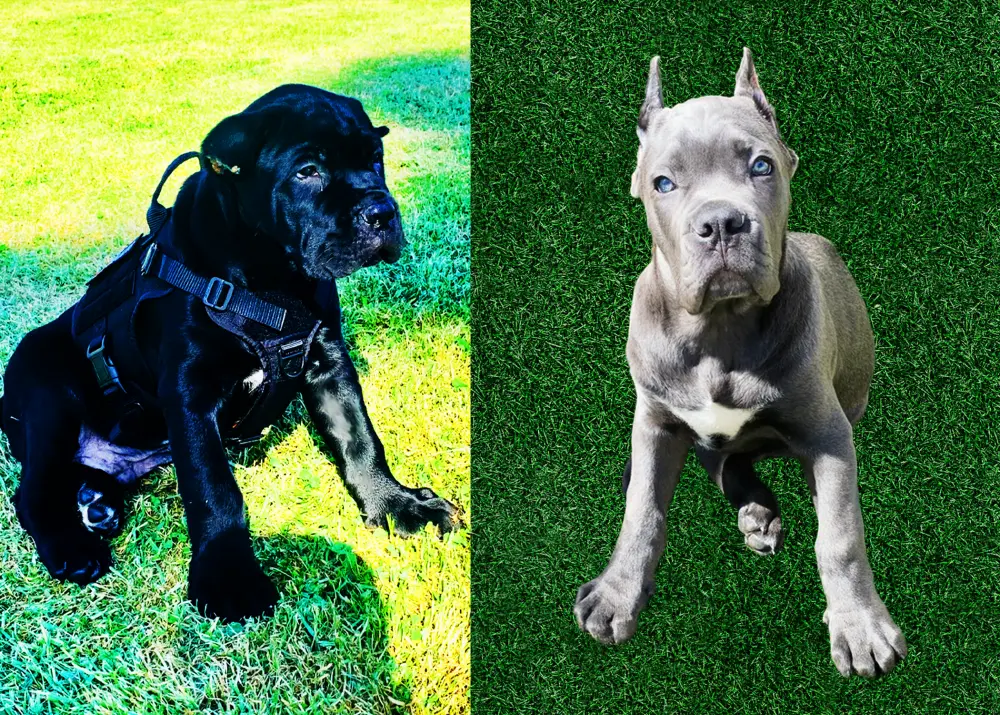
Black, grey, fawn, red, brindle, “blue,” “formentino,” “straw,” “white”: Cane Corso color names multiply fast in puppy ads. This guide sorts them into what the breed standards accept, what they don’t, what’s genuinely linked to health, and what’s just a sales story. Every rule quoted here comes from the FCI standard, the AKC standard or the US parent club’s judges’ manual.
Short answer: The standards accept black, shades of grey (often sold as “blue”), shades of fawn, red, and brindle versions of these. Black-and-tan patterns are disqualified by the AKC, and colors not listed are disqualified by the FCI. No color is healthier or “better” by default, though dilute (grey/blue) and fawn coats carry a known risk of a skin condition called color dilution alopecia, and one study linked brindle coats to a longer median lifespan.
- Choose by color if you simply love a look and the breeder’s health testing is solid. Color is cosmetic.
- Be cautious with “rare” colors priced at a premium, especially any color the standards don’t list, or a grey dog from a breeder who can’t talk about skin and coat health.
What colors do Cane Corsos come in?
Cane Corsos come in black, grey, fawn and red, plus brindle on those base colors. The wording differs slightly by standard:
- FCI (international) standard: “Black, lead-grey (blue), slate-grey (blue), light grey (blue), light fawn; dark fawn and stag red; dark wheat colour; black brindle, grey (blue) brindle.”
- AKC standard: “Acceptable colors are black, lighter and darker shades of gray, lighter and darker shades of fawn, and red. Brindling is allowed on all of these colors.”
- CCAA judges’ manual (US parent club): lists solid black; fawns “from light fawn to dark apricot red”; greys “from charcoal, slate to light grey”; and brindles “in black, grey or chestnut.”
The CCAA is explicit about ranking: “No color is preferred over another and all have significant historical value,” and “color is considered cosmetic in this breed.”
Cane Corso colors side by side
| Color | FCI standard | AKC / CCAA | What to know |
|---|---|---|---|
| Black | Accepted | Accepted | Black nose and pigment; dark eyes preferred by AKC |
| Grey / “blue” | Accepted (lead, slate, light grey) | Accepted (“shades of gray”) | A dilute color with grey pigment; color dilution alopecia risk |
| Fawn | Accepted (light and dark) | Accepted, with black or gray mask | Mask should not go beyond the eyes; CDA risk noted for fawn coats |
| Fawn with grey pigment (“formentino”) | Covered: fawn with grey (blue) mask | Covered: fawns with “black or grey pigment” | Breeder term, not a word either standard uses |
| Red | Accepted (“stag red”) | Accepted | Mask required on solid reds (AKC) |
| Black brindle | Accepted | Accepted | Longest median lifespan in one 2017 study |
| Grey (blue) brindle | Accepted | Accepted | Dilute; grey pigment |
| Chestnut brindle | Not named | Listed by CCAA | Brindling on a red/fawn base |
| Wheat / “straw” | “Dark wheat colour” accepted | Not named; falls under “shades of fawn” only if it fits the description | Pale “straw” or “cream” dogs are often sold as rare; ask how they fit the standard |
| White markings | Small patch on chest, toes, nose bridge OK; large white patches disqualify | Patch on chest, throat, chin, backs of pasterns, toes OK | A mostly white dog fits neither standard |
| Black and tan pattern | Not listed (unlisted colors disqualify) | Disqualified | Tan points like a Rottweiler’s are a DQ |
| Other colors (chocolate, liver, merle, etc.) | Disqualified (“all colours not indicated”) | Not listed as acceptable | Often marketed as “exotic”; not part of the breed standard |
Sources: FCI Standard No. 343 (2023); AKC Official Standard of the Cane Corso; CCAA Judge’s Manual 2026; Korec et al., Open Veterinary Journal 2017; VCA Animal Hospitals on color dilution alopecia.
Is there a blue Cane Corso?
Yes and no. What breeders call “blue” is the grey the standards describe. The FCI puts “blue” in parentheses after its greys: “lead-grey (blue), slate-grey (blue), light grey (blue).” The AKC and CCAA just say gray or grey. The CCAA manual adds that “grey and grey brindles are a dilute and will have grey pigment,” meaning the nose, lips and eye rims are grey rather than black.
So a “blue Cane Corso” is a legitimate, standard color, not a rare variety. It shouldn’t be priced as an exotic. Our blue Cane Corso guide and full-grown blue Cane Corso page go into the look in more detail.
Do grey or fawn Cane Corsos have more health problems?
There is one well-documented color-linked skin condition: color dilution alopecia (CDA). VCA Animal Hospitals describes it as “a genetic, recessive, inherited condition that causes patches of hair thinning or loss,” sometimes with flaky or itchy skin, and says it is “most commonly seen in dogs with a blue or fawn coat.”
A few things worth knowing:
- Puppies “are born with a normal-looking hair coat.” VCA says signs may appear “at six months of age or older,” so nobody can rule it out by looking at a young puppy.
- It’s manageable but not curable: “While CDA is not curable, it is straightforward to manage.”
- VCA names the Cane Corso among the breeds in which it has been reported. Treat it as a risk to discuss with the breeder and your vet, not as a verdict on a color.
Ask any breeder of grey or fawn Corsos whether the parents or earlier litters have had coat or skin problems. If your dog develops thinning hair, see your vet. Beyond CDA, the research for this page turned up no evidence that any standard Cane Corso color has more hip, elbow, eye or heart problems than another. Those risks come from the parents, which is why health testing matters far more than color. Our Cane Corso health problems guide covers the conditions to screen for.
Do brindle Cane Corsos live longer?
One study found they did, on average. Korec and colleagues, writing in the Open Veterinary Journal in 2017, analyzed lifespan data for 232 Cane Corsos from 25 countries. The median lifespan for the whole group was 9.29 years. By coat color, the medians were:
- Black brindle: 10.30 years
- Brindle: 10.13 years
- Grey brindle: 9.84 years
- Fawn: 9.01 years
- Black: 9.00 years
- Grey: 9.00 years
- Other: 8.09 years
Read that carefully. It’s one study of 232 dogs, it shows an association rather than a cause, and the authors themselves only said the result “may suggest a relationship” that they planned to examine further. A solid black puppy from long-lived, health-tested parents is a better bet than a brindle from untested ones. They also found no meaningful lifespan difference between the sexes: females had a median of 9.33 years and males 9.25.
For everything else that affects how long a Corso lives, see our Cane Corso lifespan guide.
What is a formentino Cane Corso?
“Formentino” is a breeder term, not a standard term, for a fawn Cane Corso with grey (dilute) pigment instead of black: a fawn coat with a grey mask, grey nose and lighter eyes. Neither the AKC standard nor the CCAA manual uses the word, but both cover the color. The CCAA says fawns “have either black or grey pigment,” and the FCI standard allows a “black or grey (blue) mask” on fawn and brindle dogs.
Because it’s a dilute color, the same color dilution alopecia caution applies. It isn’t rarer or more “pure” than other fawns; it’s a fawn with grey pigment.
Are straw, white or cream Cane Corsos real?
Pale dogs exist, but how they fit the standards is a fair question to ask. The FCI accepts “dark wheat colour” and light fawn. The AKC accepts “lighter and darker shades of fawn.” Neither standard uses the words “straw,” “cream” or “white” as a color.
White markings are limited. The FCI allows “a small white patch on the chest, on the tip of the toes and on the bridge of the nose” and disqualifies “large white patches.” The AKC allows white “on the chest, throat, chin, backs of the pasterns, and on the toes.” A mostly white dog doesn’t match either description.
If you love a pale dog, ask the breeder what color is on the registration papers and how the parents are pigmented. We’ve written more about straw Cane Corsos and white Cane Corsos.
What colors are disqualified in the Cane Corso?
The AKC has one color disqualification: “Any color with tan pattern markings as seen in black-and-tan breeds.” That means the tan-pointed pattern seen in black-and-tan breeds.
The FCI is broader. Its disqualifying faults include “all colours not indicated in the standard; large white patches.” So under FCI rules, chocolate, liver, merle, black and tan, or any other color not on its list is out.
The AKC also disqualifies “yellow bird of prey” and “blue eyes,” and the FCI disqualifies “wall eye (blue flecked).” That matters if a seller markets light or blue eyes as something special. The AKC does accept lighter eye shades in grey-muzzled dogs; it’s the yellow “bird of prey” eye and blue eyes that disqualify.
Does color affect a Cane Corso’s temperament?
Neither standard links coat color to temperament, and no study making that link turned up in the research for this page. Both standards describe one temperament for the whole breed. The CCAA manual says color “should have no bearing on a judge’s decision or award.” Temperament comes from the parents, early socialization and training. Read what the Cane Corso temperament is like for what shapes it.
Does color change as a Cane Corso puppy grows?
Neither standard addresses how a puppy’s color develops, so the adult dogs in the line are your best guide. The CCAA describes fawns that “can have subtle counter shading of light fawn on the underside” and “carbonation (black or grey tipped guard hairs) on ears, shoulders and tail,” and brindling that “can be slight or heavy.” Ask the breeder what the parents and previous litters looked like as adults. For black brindle specifically, see our black brindle Cane Corso puppies post.
Do some Cane Corso colors cost more?
You may see higher prices advertised for colors described as rare, but the standards give no reason for a premium. The CCAA states that no color is preferred and that all listed colors are historic. If a seller charges a premium for a color, ask what else you’re getting for that money: health certificates on both parents, temperament, structure. A premium for an unlisted color means paying extra for something the FCI standard disqualifies. For what a puppy should cost and why, see our Cane Corso price page.
How should you choose a Cane Corso color?
Pick health first, temperament second, structure third, and color last. In practice:
- Start with breeders whose parents have documented hip and elbow scores.
- Meet the parents and judge their temperament.
- Within a litter you like, choose the color you love.
- If it’s grey or fawn, ask about coat and skin history in the line.
- Be skeptical of any “rare” or “exotic” color priced at a premium.
What colors does King Corso Kennel produce?
Recent litters at King Corso Kennel have included blue and black puppies. Gloria King Corso, one of our females, is black. Ask us what colors are expected for the pairing you’re interested in, and we’ll tell you for the litter you reserve in.
Aston’s program emphasizes health, structure and temperament ahead of color. He started in 2014 with two dogs from a backyard breeder: a male that developed hip dysplasia and a female with cherry eye, joint problems and knee dysplasia, whose surgeries cost more than the dogs. Today our breeding dogs with published scores, Giulio Caesar, Yunis, Queen, Roxy II and Kayla, are all hip and elbow scored HD-A / ED-0, from European and Argentinian bloodlines. Meet them on our dogs page.
See what’s available on our puppies page, or call (619) 370-5227. A $500 reservation holds a puppy, and families can visit from around 4 weeks old to meet the litter and the parents.
Comparing breeds? See all our Cane Corso comparisons side by side.
Frequently asked questions
What is the rarest Cane Corso color?
There’s no official ranking of rarity, and the standards don’t reward it. The CCAA says no color is preferred. Some colors you see advertised as rare, like chocolate, liver or mostly white, aren’t accepted colors at all under the FCI standard and aren’t listed as acceptable by the AKC. “Rare” in an ad is usually a pricing word, not a quality one.
Can I reserve a Cane Corso puppy of a specific color?
You can ask, but no honest breeder can promise a color before a litter is born. What a breeder can tell you is what colors the parents are, what earlier litters from the pairing looked like, and which colors are expected. At King Corso Kennel, ask us and we’ll tell you what’s expected for the litter you reserve in, based on the parents and the pairing.
What color eyes should a Cane Corso have?
Eye color follows coat color. The AKC prefers dark brown eyes in black-muzzled dogs and approves lighter shades in grey-muzzled dogs. The CCAA notes greys “often have light amber eyes.” Yellow “bird of prey” eyes and blue eyes are AKC disqualifications, and the FCI disqualifies wall eye. Blue eyes are not a premium feature in this breed.
Is a reverse brindle Cane Corso accepted?
Neither standard uses the term “reverse brindle.” Both accept brindle: the FCI lists black brindle and grey (blue) brindle, and the AKC allows brindling on all its accepted colors. If a dog is advertised as reverse brindle, ask the breeder how it’s registered and judge it as a brindle. The CCAA notes brindling “can be slight or heavy.”
Do Cane Corsos have to have a mask?
Solid fawn and red Corsos should. The AKC says solid fawn and red dogs “have a black or gray mask” that does not go beyond the eyes, and the FCI says the mask on fawn and brindle dogs “should not go beyond the line of the eyes.” Black dogs have no visible mask because the whole coat is dark.
Which Cane Corso color is best for hot weather?
No study comparing Cane Corso coat colors in heat turned up in the research for this page, so it makes no claim that one color handles it better. Shade, water, exercise timing and the dog’s weight and fitness are the things you can control. Our Cane Corso hot weather guide covers how to keep any Corso safe through an inland San Diego summer.