
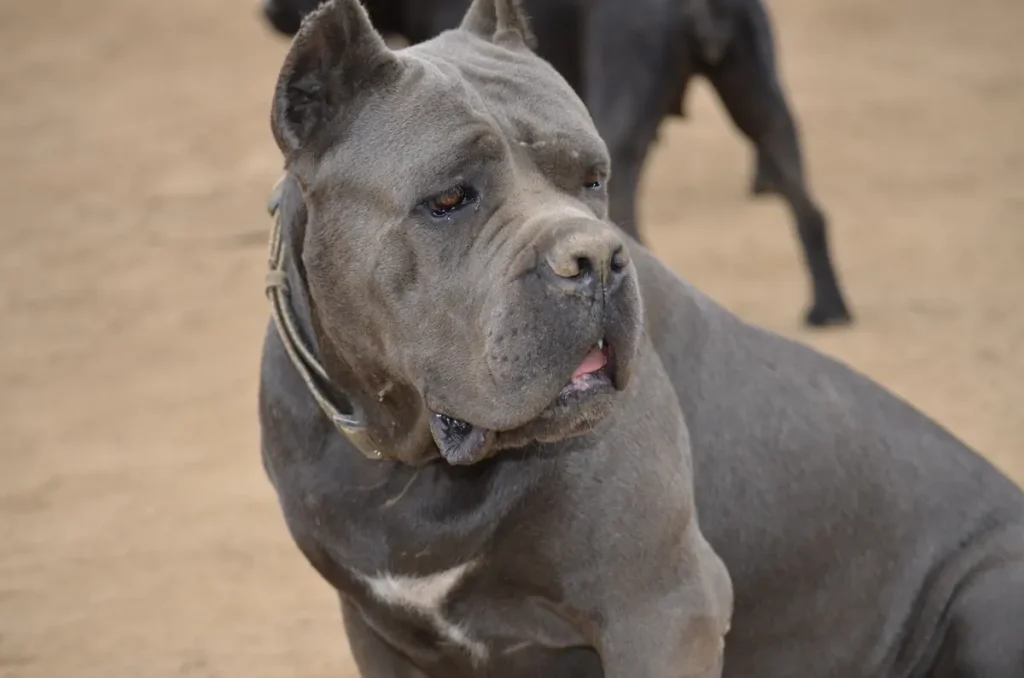
People search “Cane Corso vs pit bull” as if it were two breeds facing off. It isn’t quite that. The Cane Corso is one registered breed with one standard. “Pit bull” is a loose label that covers at least two registered breeds and a lot of mixes. Once you sort out the names, the real differences are easy to see: size, purpose, how each breed treats strangers, and what each needs from you.
We breed Cane Corsos on our ranch in Jamul, so we have a side in this. We’ll still tell you plainly where a pit bull-type dog is the better fit.
Short answer: A Cane Corso is a much larger Italian guardian bred to watch property and be wary of strangers. The pit bull-type breeds are medium-sized, athletic terriers. The UKC calls the American Pit Bull Terrier “extremely friendly, even with strangers,” and the AKC rates the AmStaff more open to strangers than the Corso. Neither is “better”; they suit different homes.
- Choose a Cane Corso if you want a large, watchful guardian, have room and time for a big dog, and will commit to serious socialization and training from puppyhood.
- Choose a pit bull-type breed if you want a smaller, energetic, people-loving companion, don’t need a guard dog, and can manage a dog that may not get along with other dogs.
| Cane Corso | American Pit Bull Terrier | American Staffordshire Terrier | |
|---|---|---|---|
| Registry | AKC (Working Group, 2010); FCI | UKC (Terrier Group); not an AKC breed | AKC (Terrier Group, 1936) |
| Origin | Italy | Bull-and-terrier crosses from Britain and Ireland, developed in the US | United States |
| Height | Males 25–27.5 in; females 23.5–26 in | Males about 18–21 in; females about 17–20 in (guideline) | Males 18–19 in; females 17–18 in |
| Weight | “Proportionate to height”; often over 100 lb (AKC). FCI: males 45–50 kg, females 40–45 kg | Males 35–60 lb; females 30–50 lb | Males 55–70 lb; females 40–55 lb |
| Life expectancy | 9–12 years | Not stated in the UKC standard | 12–16 years |
| Coat | Short, stiff, dense, light undercoat | Short | Stiff, glossy |
| Drooling (AKC 1–5) | 3 | No AKC rating | 1 |
| Energy (AKC 1–5) | 4 | No AKC rating | 3 |
| Trainability (AKC 1–5) | 4 | No AKC rating | 3 |
| With strangers | Protective rating 5/5; openness to strangers 3/5 (AKC) | “Not the best choice for a guard dog” (UKC) | Protective rating 5/5; openness to strangers 4/5 (AKC) |
| With other dogs | AKC 3/5; early socialization with other dogs “is vital” | “Most APBTs exhibit some level of dog aggression” (UKC) | AKC 3/5; “never” leave alone with other dogs |
| Health screens | Hips, elbows, patellas, cardiac; DSRA and NCL1 DNA tests | No registry list we could verify; ask the breeder and your vet | Hips, cardiac, thyroid; NCL4A DNA test |
Sources: AKC Cane Corso and American Staffordshire Terrier breed pages and the AKC Cane Corso standard; FCI Standard No. 343; UKC American Pit Bull Terrier standard (revised 2017). AKC 1–5 trait ratings exist only for AKC breeds.
Is a pit bull a breed?
No, “pit bull” is not a single breed. It’s an informal label for a family of bull-and-terrier dogs. Two registered breeds sit at its center. The American Pit Bull Terrier is registered by the United Kennel Club (UKC), not the American Kennel Club (AKC). The UKC says it was the first registry to recognize the breed, and that its founder gave UKC registration number 1 to his own pit bull, Bennett’s Ring, in 1898.
The American Staffordshire Terrier (AmStaff) is the AKC’s closely related breed. The AKC notes that when these dogs came to America, “the names Pitdog and Pitbull Terrier stuck,” and that the AmStaff was accepted into its stud book in 1936. The AKC’s breed list does not include an “American Pit Bull Terrier” or “American Bully” at all.
Then there’s the American Bully, a newer, heavier breed that the UKC recognized in 2013 and describes as “a natural extension of the American Pit Bull Terrier.” We cover it in its own comparison: Cane Corso vs American Bully and XL Bully.
Even experts struggle with the label. In a 2015 University of Florida study, shelter staff called 62 of 120 dogs (52%) pit bull-type by looks, while DNA identified only 25 (21%). The authors concluded that visual identification of pit bull-type dogs “was unreliable.” So when someone says “pit bull,” ask which dog they actually mean.
Is a Cane Corso a pit bull?
No. A Cane Corso is an Italian mastiff-type breed, not a pit bull or a terrier. The AKC places the Corso in the Working Group and describes it as a Molossus dog whose ancestors came to Italy with Roman legions. The pit bull-type breeds sit in the Terrier Group and come from 19th-century crosses between Bulldogs and terriers.
The confusion comes from looks. Both have short coats, broad heads and muscular bodies, and both are sometimes shown with cropped ears. Stand them side by side and the difference is obvious. A male Corso can be 25 to 27.5 inches at the shoulder, while a male AmStaff is 18 to 19 inches. A Corso is a big dog. A pit bull-type dog is a medium one.
Is a Cane Corso a “bully breed”? Not in any registry sense. “Bully breed” is an informal term. The AKC puts the Cane Corso in its Working Group and the FCI puts it in its Molossian, mastiff-type section; neither groups it with the terriers.
Is a Cane Corso bigger than a pit bull?
Yes, by a wide margin. The AKC standard puts male Cane Corsos at 25 to 27.5 inches and females at 23.5 to 26 inches, and says Corsi are “often weighing more than 100 pounds.” The FCI standard, whose latest amendments come from Italy’s national kennel club, gives males 45 to 50 kg (about 99 to 110 lb) and females 40 to 45 kg (about 88 to 99 lb).
Compare that with the pit bull-type breeds. The UKC’s “desirable weight” for an American Pit Bull Terrier male is 35 to 60 pounds, with a height guideline of 18 to 21 inches. The AKC lists AmStaff males at 55 to 70 pounds and 18 to 19 inches. In plain terms, a Corso at 100 pounds or more outweighs a top-of-range 70-pound AmStaff male by at least 30 pounds, and a top-of-range 60-pound American Pit Bull Terrier male by at least 40.
Size matters for daily life more than for bragging. A 100-pound dog needs a bigger crate, a bigger car, more food and a handler who can hold it on a leash.
Does a Cane Corso have a stronger bite than a pit bull?
Probably, because it’s a bigger dog, but no one has published a measured bite force for either breed that we could verify. The numbers you see online, such as “700 PSI,” have no study behind them that we could find. Treat them as myths.
Here’s what the research does say. A 1995 pilot study in the Journal of Veterinary Dentistry measured 22 pet dogs weighing 7 to 55 kg and recorded bite forces from 13 to 1,394 newtons, with most bites at the low end. A 2009 study in the Journal of Anatomy, which estimated bite force from skull measurements, found that “bite force increases as size increases.” So a larger dog with a larger head generally has more bite force available. That’s all the evidence supports.
Also note that “PSI” is pressure, not force, which is one more sign the viral numbers weren’t measured properly. And we don’t compare dogs by fighting. If you came here wondering “who would win,” the useful questions are the ones on this page: size, temperament, drive and how well the dog is raised.
How do Cane Corso and pit bull temperaments differ?
The biggest difference is how each treats strangers. The Cane Corso was bred as a guardian. The AKC rates its watchdog and protective nature 5 out of 5 and says Corsi “can be dominant and protective.” Its breed standard calls the Corso “docile and affectionate to his owner, loving with children and family,” while unequaled as a protector of property and owners.
The pit bull-type breeds are described differently. The UKC standard says the American Pit Bull Terrier “is not the best choice for a guard dog since they are extremely friendly, even with strangers,” and that aggression toward humans “is uncharacteristic of the breed and highly undesirable.” The AKC’s picture of the AmStaff is more mixed. It says AmStaffs are “intelligent and excellent guardians” and rates their watchdog and protective nature 5 out of 5, the same as the Corso, but gives them 4 out of 5 for openness to strangers, versus 3 for the Corso.
So the clearest difference is the default reaction to a stranger. Going by the standards, a well-bred Corso is warm with family and reserved with outsiders, a well-bred American Pit Bull Terrier greets outsiders like friends, and the AmStaff sits in between. Neither temperament is “safer” in itself; both depend on breeding, early socialization and an owner who stays in charge. Our article on whether the Cane Corso is an aggressive breed goes deeper.
Which is better with kids and other dogs?
With children, both can do well in the right home; with other dogs, both need care. The AKC rates both the Cane Corso and the AmStaff 3 out of 5 for “good with young children,” which in practice means supervision. The UKC says American Pit Bull Terriers “have always been noted for their love of children.”
With a Corso, the practical issue around kids is size. A friendly 100-pound dog can knock over a toddler without meaning to. With the pit bull-type breeds, the issue the registries flag is other dogs. The UKC states that “most APBTs exhibit some level of dog aggression,” and the AKC warns that AmStaffs can develop dog aggression even when well socialized and should never be left alone with other dogs.
If you already have a dog at home, that’s an important point. The AKC gives the Corso and the AmStaff the same 3 out of 5 for “good with other dogs,” and says early socialization with people and other dogs “is vital” for a Corso. But the explicit dog-aggression warnings sit in the UKC’s pit bull standard and the AKC’s AmStaff guidance, not in the Corso’s. For more on children specifically, read Are Cane Corsos good with kids?
Which is easier to train?
The AKC rates the Cane Corso a little higher, at 4 out of 5 for trainability, against 3 for the AmStaff. It calls Corsi “intelligent and eager to please,” and also says puppy classes are “a must” for a breed this big and strong. The UKC says the APBT does well in performance events “because of its high level of intelligence and its willingness to work.”
Ease of training isn’t the same as ease of ownership. A pit bull-type dog that ignores you on a leash is a problem. A Cane Corso that ignores you is a bigger one, simply because of its weight. The AKC makes the same point about classes for the AmStaff, calling early socialization and puppy training “a necessity” given its strong will and physical strength. On method, it says Corsi “respond to love and rewards far better than to harsh corrections.” Start early; our guide on early socialization for Cane Corso puppies explains how.
How much exercise does each need?
Both need daily exercise, and the Corso needs more structure around it. The AKC recommends “a brisk walk, or better yet, run, of at least a mile in the morning and again in the evening” for Cane Corsos, plus mental work. It rates Corso energy 4 out of 5 and AmStaff energy 3 out of 5.
The pit bull breeds are agile athletes. The UKC calls the APBT “one of the most capable canine climbers so good fencing is a must.” AmStaffs, per the AKC, need long play sessions with their people rather than time alone in the yard.
In inland San Diego County, where summers get hot, both short-coated breeds are best exercised in the early morning or evening. Watch for heavy panting and hot pavement, and ask your vet about heat safety for your dog.
What health problems should you screen for in each?
For a Cane Corso, the AKC lists these recommended tests: hip evaluation, elbow evaluation, patella evaluation, a cardiac exam, and DNA tests for Dental Skeletal Retinal Atrophy (DSRA) and Neuronal Ceroid Lipofuscinosis (NCL1). The AKC also notes that breeders screen for hip dysplasia, idiopathic epilepsy, demodex mange and eyelid abnormalities, and that deep-chested breeds like the Corso can get bloat, a sudden, life-threatening stomach condition.
For the AmStaff, the AKC lists hip evaluation, a cardiac exam, a thyroid evaluation and a DNA test for NCL4A, and mentions skin and coat allergies and cerebellar ataxia. The UKC standard for the American Pit Bull Terrier doesn’t list health tests, so ask the breeder which tests the parents have had (the AKC’s AmStaff list is a sensible starting point) and ask your vet what else to check.
For any puppy, ask to see the parents’ actual results, not a promise. You can read how we approach this on our health testing page and in our guide to Cane Corso health problems.
Can you own a Cane Corso or a pit bull in San Diego?
Yes. California law limits what cities and counties can do by breed. Under Health and Safety Code 122331, local breed-specific rules are allowed only for mandatory spay/neuter and breeding programs, and no breed may be declared potentially dangerous or vicious under those ordinances. In unincorporated San Diego County, dogs must be on a hand-held leash no longer than 6 feet when away from home, and a dog that bites can be declared dangerous whatever its breed.
Rules outside California differ, and landlords and insurers can set their own policies. See where the Cane Corso is banned and our California legal guide. This isn’t legal advice; check your city and your lease.
Which costs more to keep?
The Cane Corso, mostly because it’s bigger. A dog that can weigh 30 or more pounds more eats more and needs a bigger crate, bed and vehicle. For the puppy itself, our price page notes that Cane Corso puppies from reputable breeders typically run $2,500 to $5,000 or more. That’s a market range, not our price.
We don’t have verified price figures for pit bull-type puppies, and they vary widely. For a full breakdown on the Corso side, see what a Cane Corso puppy really costs.
Cane Corso or pit bull: which should you choose?
Pick the dog whose normal behavior fits your life. A pit bull-type breed is the better choice if you want a medium-sized, outgoing companion that loves visitors, if you live in a smaller space, or if a large property guardian isn’t what you’re after. It’s a harder choice if you already own dogs, because of what the UKC standard and the AKC’s AmStaff guidance say about dog aggression.
A Cane Corso is the better choice if you want a watchful guardian, have room for a large dog and can put in real time on socialization, training and exercise. It’s the wrong choice if you want a dog that greets every stranger like a friend, or if no one in the house can physically handle a 100-pound dog.
If you’re torn, meet adult dogs of each breed. A puppy’s personality is a guess. The parents’ temperament is evidence.
How does King Corso Kennel breed its Cane Corsos?
Our program emphasizes health, structure and temperament. Aston started this program after a hard lesson. In 2014 he bought a male and a female Cane Corso from a backyard breeder to protect his property. The male developed hip dysplasia and had trouble getting up. The female had cherry eye, joint problems and knee dysplasia. The surgeries cost more than the dogs, and long-term pain management followed.
That’s why our breeding dogs Caesar, Yunis, Queen, Roxy II and Kayla are all hip and elbow scored HD-A / ED-0, and why we built on European bloodlines. Our males are Giulio Caesar, from a grand champion lineage in Bosnia with original Italian genetics, and Yunis King Corso, imported from Serbia. Our females include Queen Corso from Serbia, Roxy II King Corso from an Argentinian bloodline, and Kayla King Corso, bred here. Aston describes Caesar as very lovable, very trainable and very obedient. You can meet them all on our dogs page.
Families can visit the litter from around 4 weeks old and meet the parents on our 80-acre ranch in Jamul. A $500 reservation holds a puppy, and interest-free financing is available. See available puppies or call (619) 370-5227.
Comparing breeds? See all our Cane Corso comparisons side by side.
Frequently asked questions
Can a Cane Corso and a pit bull live together?
Sometimes, but it takes planning. The UKC’s pit bull standard says most APBTs show some level of dog aggression, and the AKC says AmStaffs should never be left alone with other dogs. A Corso also needs steady socialization with other dogs. Slow introductions, separate feeding and supervision help. Talk to a qualified trainer before bringing the two together, and have a plan to separate them if needed.
Is a Cane Corso more dangerous than a pit bull?
We can’t give you a fair breed ranking, and you should be wary of anyone who does. Breed labels based on looks can be wrong: in a University of Florida study, shelter staff called 52% of dogs pit bull-type by sight, while DNA found 21%. What matters more is the individual dog’s breeding, socialization, training and containment. A bigger dog can do more harm if things go wrong, so a Corso owner carries extra responsibility.
What is a Cane Corso pit bull mix like?
There’s no way to predict it. A mix isn’t a breed, has no standard, and can inherit any combination of size, guarding instinct and dog aggression from either side. Some end up medium-sized and friendly, others large and wary. If you’re considering one, meet the parents if you can, and treat the puppy as a large, strong dog that needs early socialization.
Why do some Cane Corsos look like pit bulls?
Both have short coats, broad heads and muscular builds, and both may have cropped ears, since the AKC Cane Corso standard and the UKC pit bull standard allow cropped or natural ears. Size settles it: an adult Corso stands roughly 23.5 to 27.5 inches, while pit bull-type dogs are usually around 17 to 21 inches.
Which lives longer, a Cane Corso or a pit bull?
The AKC lists the American Staffordshire Terrier’s life expectancy as 12 to 16 years and the Cane Corso’s as 9 to 12 years, so the smaller breed tends to live longer. The UKC doesn’t publish a figure for the American Pit Bull Terrier. Those are breed-wide figures, not a promise for one dog; ask your vet what to expect for yours.
Is a pit bull or a Cane Corso better for a first-time owner?
Neither is an easy beginner’s dog, but a medium-sized, people-friendly pit bull-type dog is usually more manageable than a 100-pound guardian. A first-time owner can raise a Corso well with a good breeder, puppy classes from the start and real daily time. If you can’t commit to that, choose a smaller, less protective breed.
Are pit bulls or Cane Corsos registered with the AKC?
The Cane Corso is an AKC breed, recognized in 2010 in the Working Group. The American Staffordshire Terrier is AKC-recognized too, since 1936. The American Pit Bull Terrier and the American Bully are not on the AKC’s breed list; both are registered by the United Kennel Club, which recognized the APBT first, in 1898.